Where Nothing Stays Hidden Part2

Lorian brushes past me like I’m just part of the doorway he walked through, and for a second I’m too busy processing the fact that he’s real to notice anything else. Then I see it—the cloak. Black, long, trailing behind him like it doesn’t quite obey the same rules as everything else around it. It drags across the ground. Something lifts off of it as it moves, faint and shimmering, like the air is catching on it and refusing to let go.
I blink, watching it a little longer than I probably should.
Well.
That’s new.
I mean… I guess if you’re stepping out of some unknown realm through a gate no one’s opened in centuries, you don’t exactly show up in jeans and a t-shirt.
Still.
I wasn’t expecting… that.
His clothes were dark, layered—fitted in some places, looser in others—but not in any way that felt random. There was a structure to it. Like every piece had a purpose I wasn’t quite understanding. It didn’t look like anything I’d ever seen someone just… wear.
It looked like armor.
Not the kind you see in museums or on Halloween costumes, either. Something older. Stranger. Like it belonged in a story people stopped telling a long time ago.
Which, honestly… yeah. That checks out.
Of all the things that could’ve come through that gate—
this is what I get?
A man. Wearing … armor?
I let out a quiet breath, running a hand back through my hair as I took another look at him.
Because sure—he’s attractive. That part’s obvious. I’m not blind.
But that’s not what I opened the gate for.
I didn’t do all of this for someone who looks like he belongs in a brooding fantasy novel. I opened it because I wanted something that could tear this town apart. And now I’m standing here wondering—this is it? This is what came through?
He slows in his stride. Just enough for me to notice. And before I can decide what to say—or if I even should—something shifts.
It starts small.
The space around him bends, just slightly, like heat rising off pavement, enough to make me blink and look again to see if I imagined it.
I didn’t.
His outline wavers.
Like he’s not fully here.
Like something is pulling at him from somewhere else.
“Wait—don’t go…” I start, because I’m not about to watch the only thing that’s come through that gate disappear five minutes later without at least trying.
He doesn’t answer. He turns back instead. Looks at me. And there’s something in his expression this time—something that feels a little too knowing.
That same slight smile pulls at his mouth, the gold tooth catching the light again, like he’s aware of exactly what he’s doing.
And then—he winks.
And just like that—he’s gone. Vanished into thin air like smoke.
I stare at the spot where he was, waiting for something to happen.
Anything.
A sound. A shift. Some kind of sign that I didn’t just hallucinate the last five minutes.
Nothing.
Just the open gate behind me. The fountain still trickling like it has absolutely nothing to do with any of this.
“Unbelievable,” I mutter. “I open a gate to another world and get stood up. That feels about right.”
The air moves. Just slightly. “Don’t worry, Elana…”
The voice slips in low, carried just enough on the wind that I can’t tell where it’s coming from.
“I know what needs to be done.”
I go completely still, the realization settling in slow and certain.
Okay… so maybe not just a man. Not if he can do that. Not if he can disappear into thin air and throw his voice on the wind like it’s nothing.
My gaze drifts back to where he’d been standing, my thoughts shifting with it, something sharper taking hold beneath the surface. Because maybe I was wrong. Maybe he’s capable of a lot more than he let on.
A slow breath leaves me as the thought settles in, quiet and steady. Maybe he can do something with it. Maybe he can make them feel it—everything they’ve done, everything they’ve gotten away with. Maybe he can make the people of Larkin’s Grove regret being so… wicked.
I tilt my head slightly, watching the place where he’d been, something in my chest shifting in a way I don’t quite trust.
Because if he can do that… if that wasn’t some kind of trick—
then maybe I was wrong about him.
__________
I set out the next day with a purpose, walking down Main Street like I had somewhere to be, even though I didn’t. I told myself it was just a walk, but the truth sat a little heavier than that—I was hoping, maybe stupidly, that I’d find him again. My mysterious visitor from the other side.
It didn’t take long.
I spotted him leaning casually against one of the pillars outside the bank, like he’d been there all along, like he belonged there more than anyone else on that street. His attention was fixed on two men standing a few feet away, deep in conversation.
And I recognized one of them immediately.
He’d been at the meeting the night before. The one who sat across from me while they all took turns pretending they were being reasonable about dismissing me from my duties. He hadn’t raised his voice. Hadn’t said anything cruel outright. Just sat there, calm and composed, explaining—like it was the most logical thing in the world—that my family had wasted generations guarding something that didn’t exist. That I wasn’t necessary anymore. That Larkin’s Grove would no longer be funding a Gatekeeper.
He’d been one of the quieter ones.
The kind who lets other people do the talking while he nods along, like he’s weighing both sides. Like he’s fair. Measured.
The kind of man people trust…because he doesn’t look like the problem.
I stop just across the street and don’t say anything. I just watch.
Lorian leans against the pillar like he’s been a part of Larkin’s Grove his whole life, like this place belongs to him in a way it never has to the rest of us.
At some point, he’s changed clothes—traded whatever that was he stepped through the gate in for something that almost passes as normal. Dark, well-fitted jeans. A crisp white button-down. A worn leather jacket and sunglasses that hide his eyes, even though the sun isn’t nearly bright enough to justify them.
He blends in.
Almost.
The gold hoop at his ear still catches the light if you look long enough—the only thing that doesn’t quite belong. But no one’s looking long enough.
The man is mid-sentence when Lorian cuts him off.
“You sat there last night,” he says, calm and clear, like he’s continuing a conversation the man doesn’t remember starting. “While they dismissed the only decent person in this town. While they tore her apart. And you said nothing.”
The man blinks, thrown just enough to lose his place. He lets out a short, uncertain laugh, glancing around like he’s trying to decide if this is a joke.
And for a second, I don’t hear any of it.
Because I never told Lorian that.
Not about the meeting. Not about what was said. Not about any of it.
But then… I didn’t have to.
He knew why I opened the gate the moment he stepped through it.
So maybe this is the same.
Maybe he just… knows.
The thought settles in quiet and heavy, something I don’t quite have a name for yet.
Because whatever Lorian is—
he’s not just a man.
“I’m sorry—who are you?” the bewildered man asks, already shifting back into that practiced tone, the one that smooths everything over.
Lorian doesn’t answer immediately.
“You knew it wasn’t true,” he finally says, his voice steady as he takes another step forward. “You felt it, whether you wanted to admit it or not. This town exists because the Voss line has kept it safe.” A beat. “And you still stood there while they told your Gatekeeper she was no longer needed.”
The smile drops.
“I think you need to—” the man starts, firmer now, trying to take control of the moment.
But something catches. Right in the middle of the sentence.
He freezes.
His breath stutters, sharp and uneven, like his body forgot how to keep going. The man he’d been talking to frowns, asking if he’s alright, but he doesn’t answer.
“I knew,” he says instead, too loud, the words coming out like they’ve been waiting. “I knew it wasn’t true.”
A few people nearby turn at that.
The man’s face tightens, his hands coming up like he’s trying to steady himself, but there’s nothing to grab onto.
“I heard them—I knew what they were saying and I knew—” his voice breaks wide open. “I knew it wasn’t true.”
Now people are watching. Really watching.
“But I didn’t say anything,” he says, louder now, his voice carrying down the street. “I just sat there. I let it happen. I let them dismiss her—I knew and I still—”
His body folds in on itself.
And then he screams.
It tears out of him, raw and uncontrolled, stopping everything around him cold. Conversations die mid-word. People freeze where they stand.
His hands claw at his chest, his throat, his face—like he’s trying to get out of his own skin.
“Make it stop—” he chokes, stumbling forward.
It doesn’t.
His skin shifts. Not all at once—just enough to make it clear something is very wrong. It loosens, pulls, stretches where it shouldn’t, like it’s slipping out of place.
Someone backs away, swearing under their breath.
He screams again.
His flesh starts to give.
It pulls away in places, separating where it shouldn’t, his face dragging with it—features slipping, stretching, as something beneath begins to press through.
Not bone. Not anything I can name.
Just… something that was never meant to be seen.
Like wax left too close to a flame, his face softens and distorts, the shape of him coming undone in slow, unnatural shifts.
People are shouting now. Someone runs. Someone else stands there like they can’t move.
And through all of it, he keeps talking.
“I knew—” he gasps, his voice unraveling with the rest of him. “I knew what they were doing—I knew it was wrong—I just didn’t want them to turn on me—”
His head snaps toward the horrified man in front of him.
“You knew too.”
And then he lunges.
His hands clamp around the other man’s throat, dragging him down, fingers tightening with a strength that shouldn’t be there anymore. The other man chokes, panicking, trying to pull free.
“You didn’t say anything either—” he forces out, his voice breaking apart. “You stood there—you heard it—you knew—”
The street erupts. People screaming. Running. No one stepping in.
And through it, I look at Lorian.
He’s standing off to the side, watching it all unfold nonchalantly.
That same faint smile on his face.
Like this is exactly what he came here to do.
__________
I go straight home after what happens on Main Street—after the screaming, after the crowd breaks apart, after Lorian disappears like he was never there to begin with. I don’t stay to see how it ends. I don’t stay to hear what people are saying.
I make tea. Strong and scalding hot.
And then I clean.
Not the usual kind. Not the things you do to keep a house presentable. I mean the places no one touches. The corners behind furniture that hasn’t been moved in years, the tops of shelves, the edges of rooms that have just… existed, quietly collecting time. I scrub things that don’t need scrubbing, reorganize things that were fine where they were, open drawers I haven’t opened in years just to see what’s still inside.
Anything to keep moving.
Anything to keep from sitting still long enough to think about what I just saw.
Because, technically—
it’s not my problem anymore, is it?
They made that very clear.
No more Gatekeeper. No more responsibility. No more standing watch over something they decided didn’t exist.
So whatever’s happening out there—
whatever Lorian is doing—
that’s on them.
This is exactly what I wanted, wasn’t it? What else did I think was going to happen? Maybe not… that—maybe not watching a man’s skin melt from his bones in the middle of Main Street—but still. This is what I asked for. This is what I chose. And if I’m being honest about it… it feels a lot like justice. Doesn’t it? It’s what they deserve.
I tell myself that more than once as the house slowly shifts around me, as the light fades, as the quiet settles in heavier than it should.
__________
By the next morning, the town is already talking - but it’s scattered, disjointed, passed from one person to the next in pieces that don’t quite line up. Fragments. Half-stories. Enough to know something happened, but not enough for anyone to agree on what it actually was.
By midday, word spreads that there’s going to be a meeting at the town hall. An “opportunity to address concerns.”
Of course there is.
I get there early enough to slip in without being noticed, taking up a place near the back where I can see everything without having to be part of it. The room fills quickly. Same people. Same faces. Same quiet urgency, like if they handle this the right way, they can still contain it.
Like they still think this is something that can be managed.
And then—they begin.
The mayor stands at the front of the room, hands braced lightly against the table, posture steady, composed. He looks exactly the way he always does—pressed shirt, controlled expression, the kind of presence people lean on when they don’t want to think too hard for themselves.
“What happened yesterday,” he says, voice calm, measured, “was a tragic and highly unusual series of events.”
A pause. Just long enough to let that settle.
“There were two fatalities.”
The words ripple through the room, quiet but heavy. People shift in their seats, glancing at one another, like saying it out loud somehow makes it more real than it was yesterday.
“The first,” he continues, “appears to have been a medical incident. Sudden. Severe. We are waiting on official confirmation, but at this time there is no indication of foul play.”
My jaw tightens.
A medical incident.
That’s what we’re calling it now.
He doesn’t say what everyone saw. Doesn’t say how the man’s face… melted. How it came apart in a way that doesn’t exist in any version of reality that makes sense.
He just smooths it over.
Makes it smaller.
Manageable.
“The second,” he goes on, “was the result of an altercation. Again, we are gathering details, but there is no reason to believe this was anything more than an isolated act of violence.”
A man was strangled in the middle of Main Street.
In broad daylight.
In front of half the town.
And this—this is how they’re telling it.
A few people nod. Not because they believe him. Because it’s easier.
Because if this is just two tragedies—two unfortunate, unrelated events—then it means everything is still the way it’s always been.
Safe.
Contained.
I scan the room without meaning to.
And then I see him.
Lorian.
Closer to the front this time, standing just off to the side. At some point, he’s changed his clothes again. He looks like he stepped straight into place—like he understands this world well enough to move through it without friction.
And then, as if he feels my stare, he turns.
His eyes find mine instantly.
That same slow, knowing smile spreads across his face. He gives the faintest wink, like we’re sharing some private joke no one else in the room is in on. The gold tooth flashes in the light, subtle but unmistakable.
And there it is again.
That pull.
Because he is—ridiculously, unfairly—attractive.
And something else.
Something sharper.
Dangerous.
He turns back toward the front like nothing happened.
Like he didn’t just remind me that he’s the reason we’re all here.
A hand goes up somewhere near the center of the room.
“That’s not what I saw,” someone says from the left side of the room, louder this time, like they’ve already tried saying it quietly and been ignored.
“It wasn’t panic,” another voice cuts in, closer to the front. “His face—there was something wrong with his face.”
A murmur spreads, uneven and unsettled. People shifting in their seats, glancing sideways, measuring how far they’re willing to go with it.
And then someone says it again.
“His face melted,” a man near the back says, his voice tighter now, like the words are forcing their way out whether he wants them to or not. “I saw it. It came apart right in front of us.”
The room stills in a way that doesn’t feel natural. Not quiet—just… held.
He lifts his hand slightly, already moving to steer the conversation somewhere safer, something he can contain.“We understand that yesterday was upsetting, but speculation isn’t going to help—”
The doors open.
It isn’t loud. There’s no dramatic crash or sudden movement. Just the quiet click of the handle and the slow, steady swing of wood against hinges.
Still—
every head in the room turns.
Three women step inside.
For a second, there’s nothing to react to. Nothing immediate. They’re dressed the way they always are. Hair done. Faces composed. If you passed them on the street, you wouldn’t look twice.
But that’s when it hits me.
I know who these women are.
I saw them last week. At the bank.With the mayor and other “upstanding” citizens.
They move down the center aisle without hesitation, their pace even, unhurried. Not cautious. Not confused. There’s no flicker of uncertainty in them at all—just a quiet, deliberate certainty that feels out of place in a room like this.
Like they already know how this ends.
The first woman—Evelyn—reaches the front.
She doesn’t stop where she should. Doesn’t leave space between them the way people do in public, the way they’re expected to.
Instead, she steps directly into the mayor’s space.
Close enough that he has to lean back slightly to look at her.
Close enough that everyone in the room feels it.
And then she lifts her hand.
Her fingers settle lightly against his chest, smoothing over the front of his shirt like she’s done it before. Like she knows exactly where to touch. The gesture is intimate in a way that doesn’t belong here—too familiar, too practiced.
The mayor goes completely still. Not just surprised. Caught. The color drains from his face so quickly it’s almost jarring, like something inside him has been pulled loose all at once.
“Evelyn,” he says, and for the first time since the meeting began, his voice isn’t steady. It thins out, stripped of that practiced calm. “What are you—what are you doing?”
She doesn’t respond.
Doesn’t look at him.
Her gaze drifts past him, out across the room, slow and unfocused, like she’s looking through everything instead of at it. Like whatever part of her would recognize this moment—recognize him—is somewhere else entirely.
Her hand doesn’t move from his chest.
If anything, it presses in just slightly.
Holding him there.
And then she speaks.
“I told you no one would notice.” Her voice is soft. Flat.
There’s no hesitation in it. No emotion. The words don’t feel chosen—they feel released, like something that’s been sitting behind her teeth for too long and finally found a way out.
A chair scrapes sharply against the floor. Evelyn’s husband is on his feet now. He’s staring at her like he’s trying to force what he’s seeing into something that makes sense, like if he looks hard enough, she’ll snap back into the person he thought he knew.
“Evelyn,” he cries incredulously. “What is the meaning of this? What are you doing?”
She tilts her head slightly, like his voice reached her from somewhere far away, like it doesn’t quite belong to this moment. But she ignores him, addressing the mayor instead.
“You said it didn’t matter,” she says, her gaze drifting across the room without ever quite settling. “That we were careful. That people like us don’t get caught.”
Her fingers press lightly against the mayor’s chest, smoothing over his shirt again.
“All those photos on Facebook. All those little posts. Smiling next to our spouses and kids like we meant it.” There’s the faintest shift at the corner of her mouth, something almost amused. “We were good at it. Better than most. No one questioned it. Not for a second.”
She lets the silence stretch just a little.
“People are simple,” she says quietly. “You tell them you’re good… and they believe you.”
A ripple moves through the room—real this time. People shifting, turning toward one another, something unspoken beginning to take shape between them.
Her husband goes rigid.
“What are you talking about?” he demands, but there’s something in his voice now—something thinner, like he already knows he shouldn’t have asked.
Evelyn doesn’t look at him.
“We were better at pretending than they were,” she goes on, her voice still steady, still detached. “You at home. Me at home. Playing our parts. Showing up where we were supposed to. Saying the right things so no one ever had a reason to look closer.”
The mayor tries to pull back, just slightly, but her hand presses in again, holding him exactly where he is.
“It was easier this way,” she says, almost thoughtfully. “More exciting.”
The murmurs filling the room are now growing in crescendo.
“What is she saying—”
The second woman steps forward.
Then the third.
And something in the air shifts with them. Like the room itself has tipped just slightly off balance and no one knows how to right it again.
And suddenly it isn’t just Evelyn speaking.
It’s all of them.
Not over each other. Not loud. Not frantic.
Just steady.
Relentless.
One voice picking up where another leaves off, like they’re all part of the same thought, the same unraveling thread being pulled clean through the center of the room.
“We met after hours—”
“In the back office—”
“You said no one ever checks—”
“All those nights we said we were working late or going to the gym—”
The words keep coming, calm and precise, each one landing harder than the last.
The kind of truth no one says out loud.
The kind this town depends on staying buried.
Confessions spilling out in calm, even voices that don’t match the weight of what they’re saying. Affairs that had been buried for years. Money moved quietly through accounts no one questioned. Decisions made behind closed doors that ruined people who never had the power to fight back.
The room starts to fracture.
Voices rise. People stand. Someone laughs—too loud, too sharp, the kind of laugh that doesn’t belong in a room like this.
“Alright, that’s enough,” a man near the front says, stepping forward. “This isn’t funny—”
He stops.
Mid-step.
Not like he hesitated.
Like something stopped him.
His body locks in place, rigid and unyielding, like an invisible hand has closed around him and decided he doesn’t get to move any further.
He doesn’t fall. Doesn’t stumble.
He just… stays there.
And that’s when I see it.
At first, I think it’s the light. The way it shifts when too many people are moving at once, when bodies crowd together and shadows overlap in ways that don’t quite line up. It would’ve been easy—so easy—to leave it at that. To look away. To let it pass.
But then the woman nearest the aisle turns—and something tears with her.. A sound follows it, low and wet, like fabric being pulled apart where it’s stuck too tight, and the thing at her feet stretches with her movement—too long, too thin, clinging to her heels before snapping loose in a way that makes my stomach drop.
It isn’t her shadow.
It’s wrong.
It moves too late. Then too fast. It pools where it shouldn’t, then rises—rises—like something trying to remember how to stand.
Someone gasps. Loud. Sharp.
Because it’s not just her.
It’s happening everywhere.
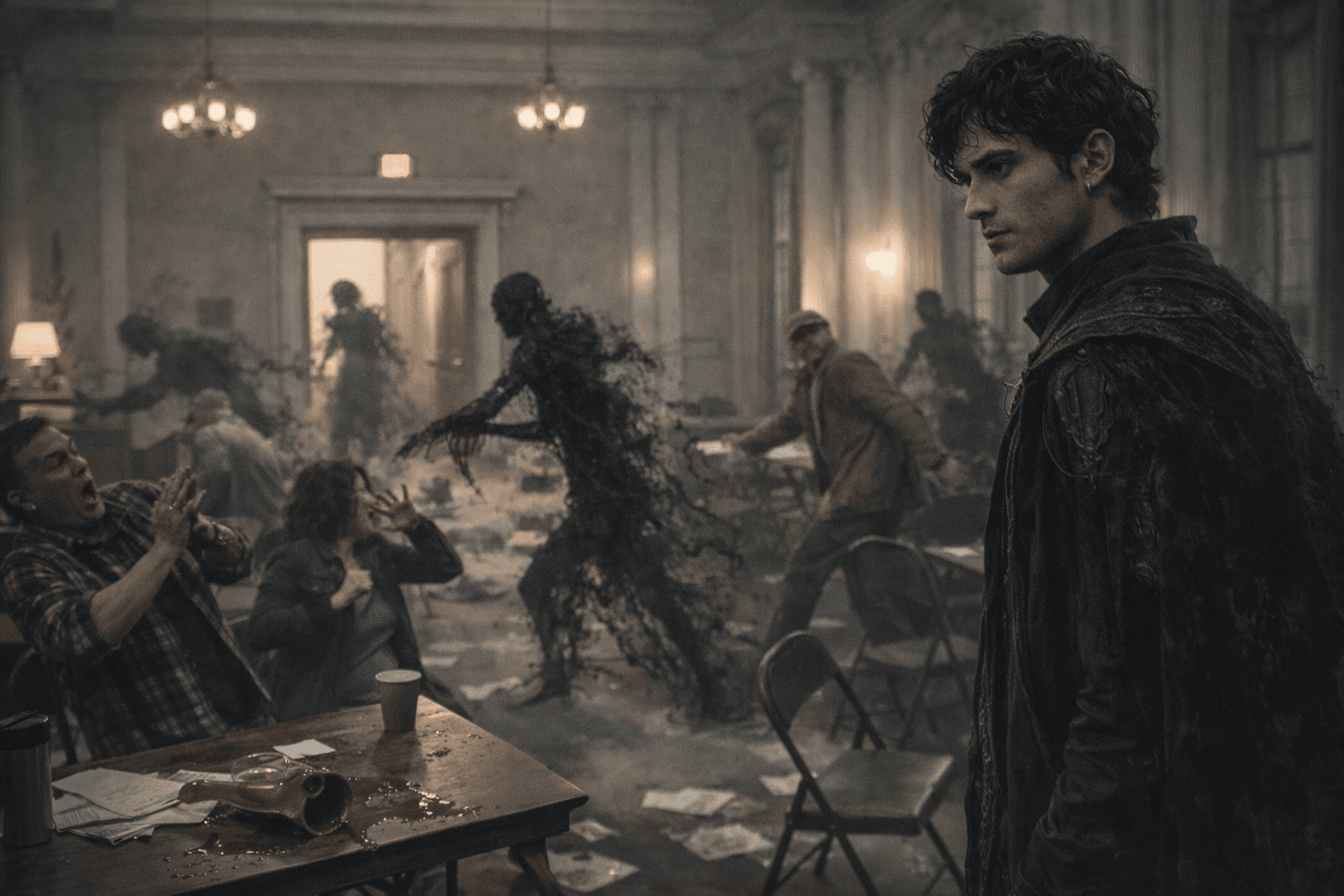
A man near the back staggers as something peels off him in a long, dragging strip, like his own outline is being pulled free inch by inch. It stretches from his feet to the floor, black and thick and moving, before it tears loose completely with a sound that doesn’t belong in a room full of people.
A woman by the door screams as hers comes away in pieces—shoulders first, then arms, then the shape of her head lagging behind like it’s caught on something unseen before it finally gives and drops.
They don’t stay flat.
They don’t settle.
They rise.
Not all at once. Not cleanly. They struggle into it, limbs forming wrong, too long in places, too thin in others, bending where they shouldn’t bend, pulling themselves upright like something learning how to be human from memory alone.
And then—
they move.
The first one lunges.
No warning. No hesitation. It throws itself forward, closing the distance between it and the man it came from in a single, jerking motion. Its arm—if that’s what it is—hooks around his shoulders and pulls him down with it.
He doesn’t even get a full scream out before they hit the floor.
More follow.
They don’t scatter. They don’t hunt. They go straight for the people they came from. Every single one of them.
The room erupts.
Not all at once—there’s a split second where no one moves, where the brain refuses to catch up to what the eyes are seeing. And then it breaks.
Chairs overturn. People shove past each other, tripping, falling, trying to get to doors that suddenly feel too far away. Someone slams into the wall. Someone else is crying—loud, choking, desperate.
And through it— the sounds. Wet. Close. Breath dragging where breath shouldn’t exist. Limbs hitting the floor in uneven rhythms. The dull, sickening thud of bodies being pulled down and held there.
I can’t look away.
Because everywhere I turn, it’s the same.
People fighting themselves.
Or something that used to belong to them.
Hands clawing at the floor. Voices breaking into screams that don’t stop. The things that tore free clinging to them, folding over them, pressing in like they’re trying to get back inside—or pull something else out.
The chaos doesn’t stop, but it shifts, like something has settled into place beneath it, something steady and deliberate holding it all together.
I feel it before I see him.
A hand closes around my elbow.
Lorian.
He draws me a half-step back, just enough to pull me out of the crush of movement without looking like he’s trying.
Like the room itself makes space for him.
For us.
“Don’t move,” he says quietly.
It’s not a warning.
It’s instruction.
And somehow, without thinking, I listen.
Behind him, someone screams again—louder this time, sharper, cut short in a way that makes my stomach turn—but Lorian doesn’t so much as glance in that direction.
His attention stays on me.
Calm. Focused. Almost… patient.
“What is happening?” I ask, my voice tighter than I want it to be, my eyes dragging back to the room despite myself. “What are those things?”
He follows my gaze then, slow, unbothered, like what’s unfolding in front of us is something he’s seen a hundred times before.
“They’ve always been there,” he says.
The words land strangely. Wrong.
“What?”
His grip shifts slightly, keeping me where I am when my instinct is to pull away, to move, to do something.
“To them,” he clarifies, his tone even. “Woven into them. Carried with them.” His gaze drifts across the room, tracking one of the writhing shapes as it drags its way over the man it came from. “Most people spend their lives pretending those things don’t exist. Those things, as you call them, are their sins in physical form.”
A man near the front lets out a strangled cry as something dark folds over him, forcing him back against the floor. His hands claw uselessly at it, slipping straight through in places, catching in others like it has weight only when it wants to.
Lorian tilts his head slightly, watching.
“It’s what they deserve, Elana,” he says, almost gently, like he’s explaining something simple. “They’ve carried those things for years. Seems only right they don’t get to outrun them anymore.”
I shake my head, but it’s slow, uncertain. “I… I don’t know,” I manage, my voice barely holding together. The words feel thin compared to what’s happening in front of me.
Because this isn’t what I had in mind.
Not even close.
When I thought about this town falling apart—about them finally facing something they couldn’t talk their way out of—I pictured something simpler. Fires, maybe. Storms. Something loud and obvious you could point to and say there it is.
But this…
This is something else entirely.
Something I never could have imagined, not even if I’d tried.
Another scream cuts through the room, followed by a wet, choking sound that I don’t want to understand. The shadows—if that’s what they are—don’t scatter. They don’t move aimlessly. They stay fixed to their people, locked to them in a way that feels… inevitable.
“They’re being torn apart,” I say, the words coming out before I can stop them.
Lorian glances at me then, something almost like approval flickering behind his expression.
“No,” he says quietly.
He leans in just slightly, close enough that I feel the words more than I hear them.
“They’re being revealed.”
Another body hits the floor.
Another shape folds over it, pressing in, forcing something out—something I can’t see but feel all the same.
“They are their sins,” he says simply. “Given form. Given will.”
Something in me snaps.
I wrench my arm free before I even realize I’ve decided to move.
I don’t look at him. I don’t look at the room. I just turn and push through the crowd, past overturned chairs and bodies scrambling to get out of each other’s way, past the sounds I don’t want to name. Past blood pooling on the floor. Someone grabs at me as I pass—whether for help or to pull me back, I don’t know—but I shake them off and keep moving.
The doors are already open.
I don’t remember reaching them.
One second I’m inside—
and the next I’m out.
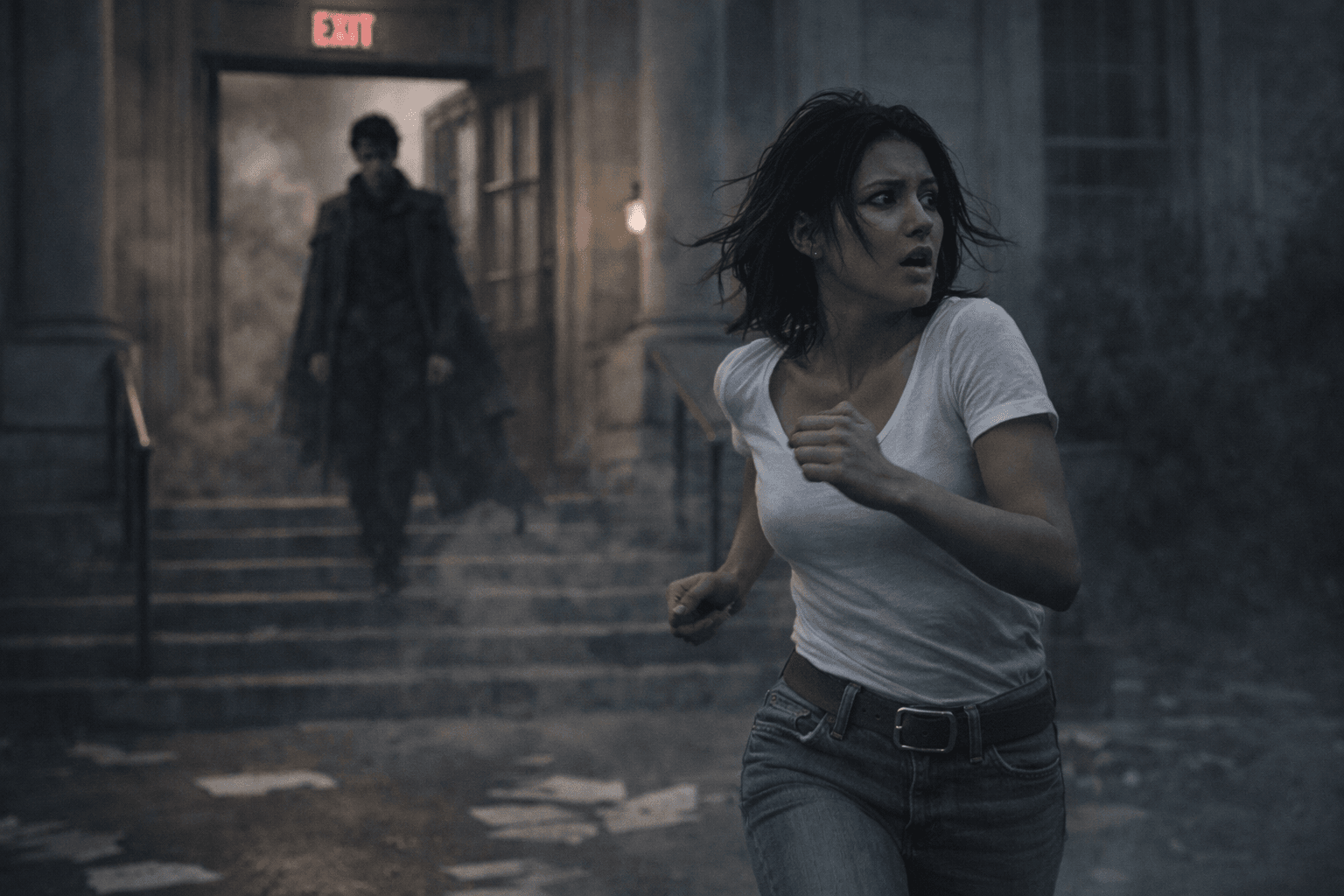
The air hits me hard, colder than it should be, like stepping into something that’s already been disturbed. I don’t slow down. I don’t think. I just run.
Down the steps. Across the street. Past the storefronts I’ve seen my entire life.
And then I hear it.
Not from behind me.
From everywhere.
Screams.
Not one. Not two. Dozens. Cutting through the town in jagged bursts—sharp, panicked, wrong. They echo off the buildings, overlap, rise and fall in a way that makes it impossible to tell where they’re coming from.
Everywhere.
It isn’t just the hall.
It’s the whole town.
My chest tightens, breath coming too fast now, but I don’t stop. I can’t. My feet keep moving, carrying me forward on instinct alone, turning corners without thinking, taking the path I’ve walked a thousand times without ever needing to look.
Behind me, he laughs.
It starts low, almost quiet enough to miss if I weren’t already straining to hear anything that doesn’t belong. Then it builds, not louder in the way a person running after you would be, but closer—like distance doesn’t matter to it at all. There’s no rush of footsteps, no sound of pursuit. Just that laughter, steady and certain, threading its way through the air behind me as if it knows I won’t outrun it.
And somehow… it follows anyway.
It curls through the air, threads through the noise of the town, settles somewhere just behind me where I can’t quite place it but can’t escape it either.
I don’t look back.
I won’t.
I run harder.
The streets blur together, familiar landmarks twisting into something that doesn’t feel quite right anymore. Doors slam somewhere in the distance. Glass shatters. Another scream cuts through the air, closer this time, and I flinch but keep moving.
Home.
That’s the only thought left.
I reach it without remembering the last stretch of road. My hands are shaking as I fumble with the door, nearly dropping the key before I finally manage to get it in, twist it, shove my way inside.
The door slams behind me harder than I mean for it to.
I lock it.
The house is silent.
Too silent.
I stand there for a second, listening.
Nothing.
No screams.
No footsteps.
No laughter.
My breath comes sharp and uneven, too loud in the quiet. I force myself to move, backing further into the house, away from the door, away from the windows, like putting distance between me and the outside might somehow put distance between me and everything that’s happening out there.
I sink down onto the edge of the couch before my legs give out completely, my hands still shaking, my pulse refusing to slow.
This isn’t what I meant.
The thought comes uninvited.
I didn’t—
I close my eyes, pressing my hands against my face like I can block it all out, like I can rewind to before I ever touched that gate.
But it’s already here. All of it.
And then I hear it—soft, close, too close—a voice right beside my ear.
“This is exactly what you wanted.”
I freeze. Every muscle in my body locks in place as the words settle in, low and certain, like they’ve been waiting for me to stop running long enough to hear them. I don’t open my eyes. I don’t move.
Because I know I’m not alone.