What The Swamp Remembers ~ Part 3
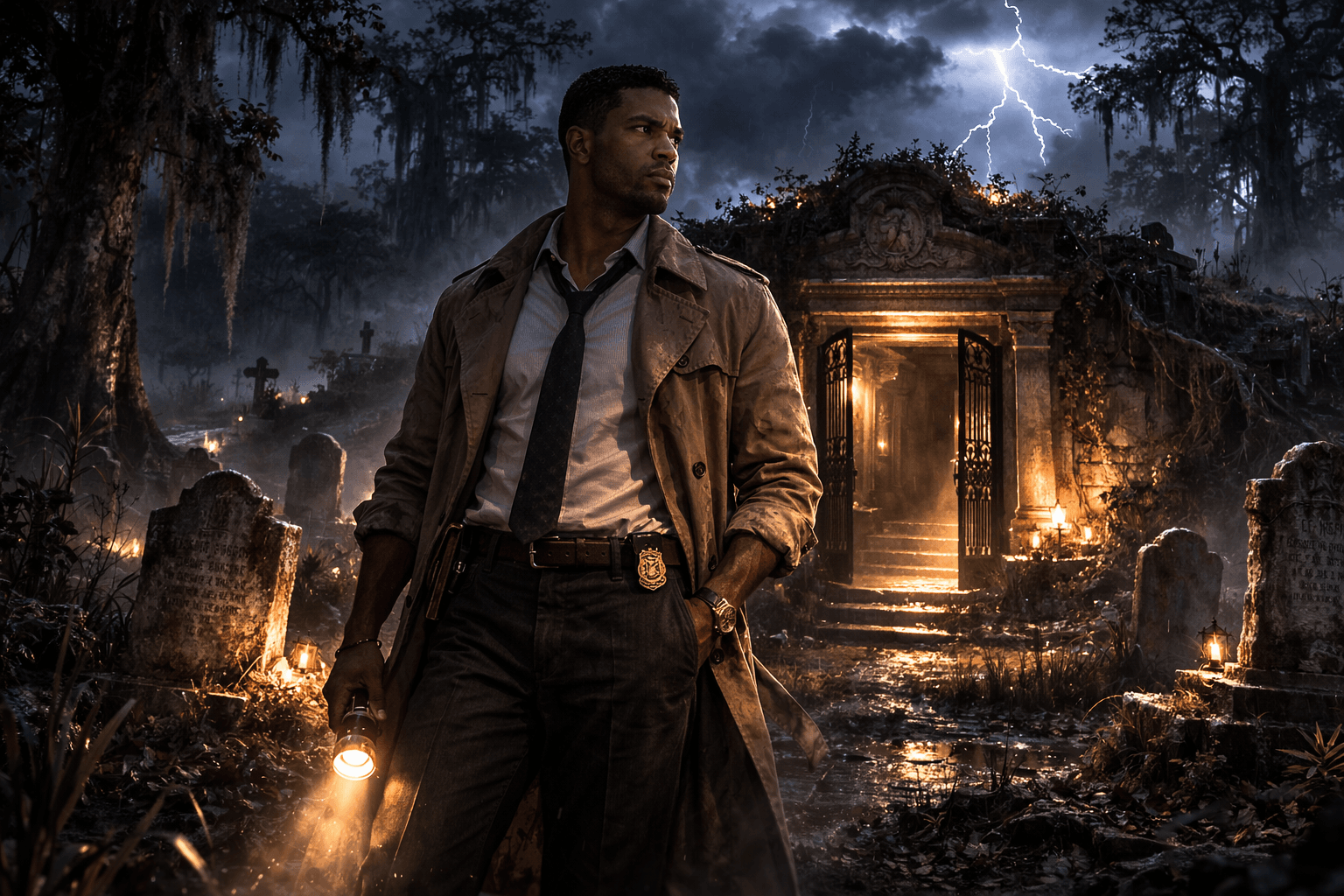
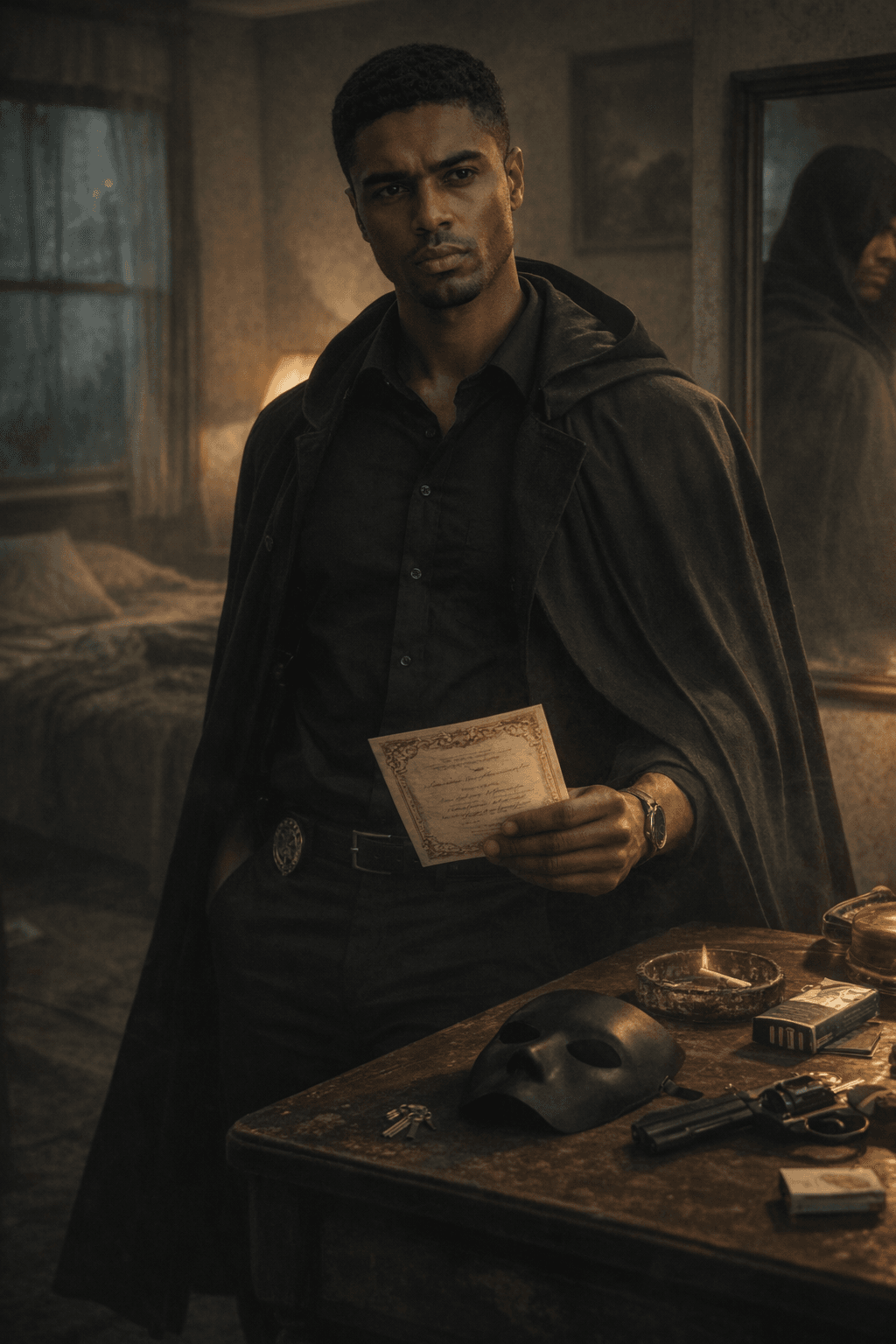
Someone had been in his house while he was out.
The thought arrived fully formed — unwelcome, uninvited, and certain in a way instinct sometimes was before reason had a chance to catch up. It settled into his chest with the same cold finality as the blood-smeared warning that had greeted him that morning.
Go Home.
Was it the same someone who had written it there on the siding in the murder victim’s blood?
It had to be.
Why leave the picture?
What were they trying to tell him?
Julian turned the photograph over again, slower this time, as though expecting the ink itself to shift beneath his gaze.
Eliza Broussard — Belle Veil Plantation, 1948
Whoever had placed this here hadn’t done it out of sentiment. This wasn’t nostalgia. It wasn’t an oversight.
They wanted him to know that they knew.
They knew who he was.
They knew who his mother was.
And they knew exactly how he was connected to the plantation — the same plantation now sitting at the center of fourteen ritualized murders and eight missing persons who had vanished without so much as a witness.
He stood there, the photograph trembling slightly between his fingers, the quiet of the house pressing in on him from all sides. The refrigerator hummed in the kitchen. The boards creaked somewhere overhead as the night air shifted through the frame. Even the insects outside seemed to hold their breath.
Then the lamplight shifted.
Something beneath the writing caught the glow.
He frowned and angled it closer.
An impression.
So faint he might have missed it entirely if he hadn’t tilted the photograph just so — the paper wasn’t smooth. The fibers had been pressed, flattened in places, raised in others, as though it had once been forced hard against something carved. Something uneven. Something meant to leave a mark.
Curving lines surfaced first.
Then angles.
Intersecting.
Breaking.
The mausoleum.
He had seen this before.
On stone.
His hand trembled slightly as he brought the photograph closer to the light. The ink of her name followed the shallow ridges beneath it — dipping almost imperceptibly where the impression ran deepest, as though it had been written after.
After it had been pressed there.
It was the same pattern.
The same symbols from the doorway.
A flicker of nausea rolled through him, sharp and sudden. He dropped the photograph onto the table as though it might burn him — but his eyes stayed fixed on it, drawn back against his will.
Someone had pressed it there.
Against that stone.
Knowing what it would take with it when it was pulled away.
Knowing it would leave a mark.
For him.
Why?
He pushed back from the table too quickly. The chair scraped once against the floorboards before tipping over behind him with a hollow crack that sounded far too loud in the small room.
This was ridiculous.
He’d assumed he’d been sent here as punishment for—
No.
He wouldn’t think about it.
But this… this didn’t feel random. It felt placed. Deliberate. As though someone had known his connection to St. Brigitte Parish before he did. As though this had been waiting for him — not for the Bureau, not for the sheriff, but for him specifically.
He could leave.
Get in the car. Drive back to New Orleans. Forget the parish. Forget the photograph. Forget the mausoleum buried out beyond the graves.
Of course, he wouldn’t have a job either.
Julian turned toward the cabinet and wrenched it open harder than necessary.
A bottle of bourbon sat shoved toward the back — already opened, a few inches gone.
He didn’t bother with a glass.
The liquor was cheap. It burned on the way down — hot and sour — scraping along the back of his throat before settling into his chest with a slow, spreading warmth that took the sharpest edge off the panic.
But it never took the memories.
It only dulled the impact when they came rushing back.
A memory — or something that only pretended to be one — forcing its way to the surface whether he wanted it there or not.
It had started over a year ago.
Not dreams, exactly. Not hallucinations — at least not in any way he could admit out loud without losing his badge entirely.
Flashes.
Moments that arrived fully formed in the middle of ordinary things — while he was driving, while he was reading a case file, once even while he was standing in line for coffee — so vivid they left his heart racing and his hands shaking long after they passed.
Stone where there should have been drywall.
Damp air that smelled of earth and rot.
A woman screaming somewhere he couldn’t see.
He didn’t believe they were real.
He couldn’t.
But these “memories” followed him for months — bleeding into his sleep, waking him in the night with the taste of dread at the back of his throat and the certainty that something had been standing just out of sight.
And it was one of those moments — one of those flashes of something that wasn’t supposed to exist — that had made him hesitate.
That had made him break protocol during a hostage rescue.
That had cost a woman her life.
—
9 Months Ago…
Julian knew it wasn’t real.
It couldn’t be.
Because the hostage had already been secured.
He’d been the one to find her.
Second floor. Back bedroom. Wrists zip-tied to the bed post while the team finished clearing the structure. She’d been shaken but conscious — young, mid-twenties, still wearing the grocery store uniform she’d been taken in two days earlier.
Alive.
Contained.
Safe.
Procedure from there had been simple.
Clear the rest of the house. Top-down. Contain the suspect before extraction.
Julian had taken the rear hallway on the first floor while his partner moved upstairs to stay with the hostage until transport arrived.
That was when he heard it.
A woman screaming.
Soft at first.
Then sharper.
Close.
Too close to be upstairs.
For a second, he thought it was her — that something had gone wrong, that the suspect had doubled back somehow — but the sound wasn’t coming from above.
It was coming from behind the basement door.
Julian stopped.
Listened.
The scream came again — strangled halfway through, like the breath had been torn from her chest.
And the hallway—
The hallway didn’t feel like a hallway anymore.
That’s when the flashback started…
The air turned heavy. Damp. Thick with the smell of mildew and standing water. The drywall in front of him seemed to warp at the edges, like something was pressing against it from the other side.
Stone.
He swore he saw stone where there should have been plaster.
Carved.
Opening.
Hands clawed at the edge of it — a woman’s hands — nails splitting as something dragged her backward into the dark beyond.
Her eyes found his.
Locked onto him like he was the only thing in the world that might save her.
“Cross.”
His partner’s voice snapped through the moment.
Close.
Real.
The hallway lurched back into place.
Drywall. Peeling paint. Cigarette smoke ground into old carpet.
The basement door sat directly in front of him, scuffed near the handle — as if someone had been kicking at it from the other side.
But he could still hear her.
Still feel the pull of it low in his chest.
“Cross, what are you doing?” his partner hissed over comms. “We’ve got the hostage. Do not open that door.”
Protocol agreed.
Suspect believed to be alone.
Hostage secured upstairs.
Hold position until full containment.
Julian knew the drill.
He’d run it a hundred times.
But the screaming—
It hadn’t stopped.
Not in his head.
Not in his ears.
It sounded like she was right there.
Waiting.
He reached for the handle before he understood why.
“Cross—”
The latch clicked.
The door opened inward.
And the suspect came through it.
He’d been hiding just behind the frame, tucked into the blind spot with a weapon already drawn — waiting for exactly this.
He moved fast.
Slipped past Julian’s shoulder before either of them could react.
Julian turned—
Too late.
The first shot hit his partner upstairs through the vest.
The second—
Down the hall.
Toward the staircase.
Toward the place where the hostage had been secured at the landing.
Julian saw her jerk as the bullet struck.
Saw her body fold forward against the rail.
Still alive for a second—
Long enough to look down at them.
Confused.
Hurt.
Like she was trying to understand why the man who was supposed to save her had opened the door that let her killer reach her at all.
—
His partner survived.
Broken ribs.
Collapsed lung.
Months of recovery.
The hostage didn’t.
—
Julian hadn’t told them about the strange flashbacks.
About the stone hallway.
About the woman being dragged through a doorway into writhing darkness.
He hadn’t told them that when he closed his eyes at night, he still saw her hands clawing at something that wasn’t there — fingers slipping against the edge of a doorway carved from stone.
Still heard the sound she made when whatever was on the other side finally pulled her through.
Because it hadn’t been real.
It couldn’t have been.
—
But standing there now, in a rental house that wasn’t his, in a parish he hadn’t known he’d been born in, holding a photograph pressed with the same symbols carved into the stone beneath Belle Veil—
Julian felt that same pull settle low in his chest.
Someone had taken this photograph down into the underground chamber.
Pressed it against the carvings on the stone threshold.
And brought it back out again.
Then left it on his kitchen table like a calling card.
Not as a warning.
As an invitation.
—
The days that followed blurred together in a way Julian would struggle to recall later—long hours spent moving between the parish records office, the sheriff’s station, and whatever back room the coroner was willing to let them work out of without asking too many questions.
They pulled attendance lists from private caterers.
Delivery manifests.
Maintenance logs from companies Crowley had hired to service the grounds.
Traffic citations issued on the access road leading up to Belle Veil.
Even utility spikes tied to nights when the plantation hosted its larger gatherings.
Every line of inquiry circled back to the same place.
And every time they thought they were getting close—
Something slipped through their fingers.
On the fourth day, a bartender who’d worked one of Crowley’s winter events failed to show up for her shift downtown.
By the sixth, a Tulane grad student last seen leaving a Belle Veil party in early spring stopped answering calls from his family in Baton Rouge.
Two more missing.
No bodies.
No witnesses.
No signs of struggle.
Just absence.
Julian began to understand why the locals spoke about the disappearances the way they did—low-voiced, half-superstitious, like something you didn’t name too loudly in case it heard you.
—
It was the seventh day when the church’s name appeared in the paperwork for the third time.
Our Lady of the Mire.
At first it looked like coincidence—
A funeral service held for one of the family members of the victims months before they vanished.
A charity gala Crowley had sponsored on behalf of the parish.
A donation large enough to cover the church’s roof repairs after last year’s storms.
But then came the ledger entries.
Guest lists for Belle Veil gatherings that included Father Lucien’s name.
Multiple times.
Not as officiant.
As attendee.
Julian sat with the file open in his lap long after the sheriff had moved on to something else, reading the dates over and over again.
Religion ran deep in Saint Brigitte Parish.
Catholic roots older than the state itself.
But what passed for faith here felt… different.
Less like doctrine.
More like tradition layered over something older, something darker.
Candles burned for saints whose names people couldn’t pronounce.
Charms hung beside crucifixes.
Offerings left at roadside shrines that weren’t listed in any church registry.
And now the parish priest was showing up at the same private gatherings tied to fourteen murders and counting.
Julian closed the file.
Yeah.
Whatever passed for faith in this place wasn’t what it claimed to be.
—
Nine days in, and they were no closer to finding the killer than they’d been the morning Julian first arrived.
If anything, the case had only grown wider—names stacking up faster than they could be cleared, alibis that didn’t quite hold, timelines that bent just enough to be inconvenient but never enough to break. Every lead seemed to circle back on itself, pointing nowhere and everywhere all at once.
His suspect list had stretched into something unmanageable.
And the sleep wasn’t coming.
Not really.
Most nights he lay awake in the narrow bed at the rental, staring into the dark, replaying evidence timelines in his head until they blurred into the memory of runes carved into stone—into the low hum he still couldn’t explain, into the photograph left waiting on his kitchen table like an answer he didn’t yet understand how to ask for.
All he wanted now was to solve this case—
and go home.
Sheriff Thibodeaux knocked once before stepping into his temporary office at the station later that afternoon.
“You’re gonna want to see this,” Sheriff Thibodeaux said, stepping inside without waiting for an answer.
Julian didn’t look up right away. He was still bent over files, eyes tracing the connections that ran between the missing bartender to a party guest list dated three months back.
“We’ve got half the parish tied to that place already,” he muttered. “Unless you found something that puts Crowley in the ground with them, it’s probably not—”
She dropped it on his desk.
The sound was louder than it should’ve been.
Julian straightened, frowning slightly, and picked it up.
An invitation.
Printed professionally on thick cardstock, the kind that cost enough to suggest whoever ordered it hadn’t needed to check a budget first. The words Belle Veil Plantation were embossed across the top in gold leaf, the edges catching the overhead light in a way that made them look almost wet.
Beneath it:
A Private Invitation.
He scanned the rest in silence.
Music.
Catered.
Masks required.
End of Season Celebration.
Invite-only.
His jaw tightened.
“You’ve gotta be kidding me,” he said quietly.
Sheriff Thibodeaux moved around to the other side of the desk, folding her arms. “My sister-in-law got it.”
Julian looked up.
“She cleans houses out near Lafayette,” the sheriff went on. “One of her regular clients had this delivered yesterday morning. Handed it off like it was nothing more than a dinner party.”
Julian glanced back down at the card.
“Your sister-in-law just decided to pass it along?”
“She brought it to me this morning,” the sheriff said. “Figured it might have something to do with everything that’s been going on out there.”
Julian flipped the card over.
Nothing.
No address.
No contact number.
Just a date stamped neatly across the bottom—
Circled in red ink.
June 21st.
“If it’s invite-only,” he said slowly, “how does this help us?”
The sheriff leaned forward slightly, tapping the corner of the cardstock with one finger.
“There’s no name on it,” she said. “No RSVP. No guest list attached. You show that at the party, they’re gonna assume you belong there.”
Julian lifted his gaze from the invitation and looked across the desk at her.
“You want me to use this.”
“I want you to get inside that house,” she replied, her tone steady but firm. “They’re expecting guests, not ID checks. You show up wearing a mask and hand that over at the door, you’re not a federal agent—you’re just another mask they don’t bother to remember. Another name on a list they’ll never see.”
Julian let his eyes fall back to the card in his hands.
June 21st.
The date sat there in clean, deliberate print.
“This is the night of the summer solstice,” he said quietly.
Sheriff Thibodeaux didn’t smile.
“No,” she answered after a beat. “It’s the night people start dying again.”
—
Julian hadn’t slept more than an hour at a stretch since the invitation landed in his hands.
Every time he drifted off, he found himself back in the mausoleum—standing in front of the carved stone doorway, the runes burning low and steady in the dark.
Waiting.
Sometimes he dreamed the door was already open.
Sometimes he dreamed something was on the other side of it, just beyond the seam of light, waiting for him to notice.
Most nights he woke before that part—sweat-soaked and breathing hard, lying in the narrow rental bed with his eyes fixed on the ceiling, listening.
For footsteps.
For movement outside the window.
For the sound of something circling the house in the dark.
By the time the night of Crowley’s solstice gathering arrived, exhaustion had settled into his bones like damp.
He dressed slowly, deliberately, like muscle memory might keep his hands steady where sleep had failed. Dark slacks. A plain button-down. Nothing that would catch the eye in a room full of strangers looking for someone else to notice.
The cape felt ridiculous when he first lifted it from the back of the chair—black, hooded, heavy enough to drag at his shoulders—but anonymity had been the point. The mask went on last.
Simple.
Featureless.
He caught his reflection in the narrow bathroom mirror as he pulled the hood up.
A stranger stared back.
Good.
He adjusted the collar of his shirt, tugged the mask into place again, and told himself—quietly, like it mattered—
You’re here to observe.
Get in. Get what you need. Get out.
—
Belle Veil looked different lit for celebration.
Cars lined the circular drive and spilled out along the road beyond the gate—newer models, expensive ones, license plates from Louisiana, Mississippi, Arkansas.
Money.
Influence.
People who didn’t worry about where they parked or who might remember seeing them here later.
Music drifted across the grounds in low, pulsing waves.
Soft at first.
Then louder as he stepped out of the car and shut the door behind him.
Everyone wore masks.
That had been printed clearly on the invitation:
Costume Required.
The anonymity made it easier for people to attend without explanation.
Or accountability.
Julian adjusted the simple black mask where it sat across the bridge of his nose, the elastic biting faintly at the back of his head. The cape he’d bought from a costume shop in town hung heavier than he’d expected across his shoulders, dragging just enough to remind him it was there.
He doubted it would be enough.
His height alone would give him away to anyone who’d been looking for him.
Still—
He joined the line moving toward the house.
No one spoke above a murmur.
Laughter came in low bursts from beneath painted faces and velvet hoods.Perfume mixed with cigarette smoke and something sweeter that reminded him uncomfortably of incense and marijauna.
He found himself studying the way people moved.
The man ahead of him—broad-shouldered, confident—wore a silver half-mask and a tailored suit beneath his cloak.
The murderer?
The woman to his left leaned in close to her companion, her laugh soft and familiar beneath a porcelain mask.
Margaret?
A taller figure further up the drive moved with the stiff, deliberate gait of someone unused to celebration.
Father Lucien?
Julian’s jaw tightened behind the mask.
Underneath the costumes—
They were still the same people.
Or worse.
Maybe they weren’t.
Maybe the man who cut someone’s throat in a candlelit grove could also sip bourbon beside him now and ask about the weather. Maybe the woman who placed stones over dead girls’ eyes could dance in the ballroom without anyone noticing the blood beneath her nails.
He glanced down at the invitation in his hand as the line crept forward.
Fourteen dead.
Now ten missing.
Who would they choose next?
A dancer?
A landscaper?
A girl who thought it was just another party?
Or someone right here—standing ten feet away behind satin and lace, waiting to be invited somewhere quieter?
Julian exhaled slowly.
Get in.
Get what you need.
Get out.
—
Inside, Belle Veil pulsed with light and sound.
Lanterns hung from the banisters in uneven rows. Candles burned in thick clusters along every flat surface—mantels, windowsills, even the wide arms of antique chairs that had no business holding open flame. Velvet drapes had been drawn back from the tall plantation windows, revealing nothing but black glass and hanging moss beyond.
The swamp watched from the other side.
Guests moved from room to room in masks and borrowed identities—lacquered porcelain, feathered half-faces, velvet hoods pulled low. Someone laughed too loudly in the hallway, the sound brittle beneath the music.
A record player spun somewhere deeper in the house.
Its low hum threaded beneath the music like a second heartbeat.
Crowley moved easily through it all.
Greeting guests with a hand on the shoulder here.
A murmured word there.
Host.
Patron.
Priest, almost.
Julian watched him for a moment too long before forcing himself to look away.
He took a glass from a passing tray without thinking—clear liquid, sweating in the Louisiana heat.
Water, he assumed.
He drank half of it in one swallow before the taste registered.
Faintly metallic at the back of his tongue.
Like pennies.
Or blood.
He set the glass down on the nearest table.
Forgot about it entirely.
Time moved strangely after that.
Rooms seemed warmer than they should have been.
Voices louder.
Faces blurring at the edges as though the light couldn’t quite hold them in place.
Laughter came from behind him—
Or ahead of him—
Or somewhere too close to his ear.
Julian blinked hard and steadied himself against the wall. The floor didn’t move beneath his feet, but something inside his head did, a slow tilt that made the world feel slightly off-center.
Like gravity had shifted.
He found himself stepping back out onto the porch without remembering making the decision—drawn by the need for air that didn’t smell like smoke and perfume and whatever else Crowley had burned into the night.
The music dulled behind him as he crossed the yard.
Toward the cemetery.
The grass was damp beneath his shoes.
The night louder here—
Insects in the trees.
Water shifting somewhere beyond the graves.
He saw her almost immediately.
Margaret stood between the leaning headstones, her pale dress catching what little moonlight made it through the cypress branches above. No mask now.
Her dark hair had come loose around her shoulders, stirred by the wind moving across the open ground.
She didn’t look like she belonged to the party.
She looked like she’d been waiting there much longer than that.
Julian slowed without meaning to.
Something in his chest tightened—heat rising beneath his skin, the back of his neck prickling as though the air itself had changed.
Margaret turned slightly, her head angling as if listening for something he couldn’t hear.
Then she began to walk.
Deeper into the cemetery.
Toward the slope where the earth dipped down.
Julian hesitated.
He knew that path.
Knew what waited at the bottom of it.
The entrance to the underground mausoleum stood open.
Margaret didn’t hesitate.
She stepped inside.
The darkness swallowed her almost immediately.
Julian followed before he could talk himself out of it.
“Margaret,” he called after her.
No answer.
He tiptoed down the steps into the mausoleum behind her retreating form.
Below, the air felt warmer than it should have.
Close.
Like breath.
The carved stone doorway waited at the back of the chamber, its surface etched with the same interlocking symbols he’d seen in his nightmares all week.
The same stone doorway he’d been seeing in his flashbacks for months…
As Margaret approached—
The runes began to glow.
Soft at first.
Then brighter.
Amber-white light bleeding into the damp air like something alive beneath the stone.
Julian pressed himself back against the wall, breath caught somewhere in his throat.
“Don’t,” he said without meaning to.
Margaret lifted a hand.
Set her palm flat against the stone.
The doorway shifted with a sound like something long buried being dragged free.
Light spilled through the opening—
Cold.
Wrong.
It didn’t move like light should.
Didn’t fall across the floor or touch the walls.
It just—
hung there.
Waiting.
Margaret stepped forward.
And disappeared through it.
Julian stared after her, his pulse thundering in his ears.
The air on the other side moved.
He could see it.
Feel it—
Pulling.
Like the tide.
Julian took one step closer to the threshold.
Another.
“Get in,” he whispered to himself, though he wasn’t sure why.
“Get what you need.”
The light shifted.
Or maybe something beyond it did.
“Get out.”
Julian stepped through the doorway.
For a split second, he expected stairs.
A corridor.
A chamber.
Another room cut from the same damp stone beneath Belle Veil.
Anywhere but—
this.
Cool air hit his face.
Open air.
The sound of wind moving across water.
Julian stumbled forward, boots finding uneven ground where there should have been smooth flooring. He turned instinctively, expecting to see the mausoleum behind him—
The underground chamber.
The carved walls.
The narrow passage he’d just walked through.
Instead—
Stone.
A flat expanse of it stretching outward beneath his feet, silvered faintly by a light that didn’t belong to any sun or moon he recognized.
The doorway behind him groaned shut with a low, grinding sound that rolled out across the open dark like distant thunder.
He blinked.
Hard.
The wall was seamless now.
As though the door had never opened at all.
Julian forced himself to breathe.
This wasn’t possible.
He’d come down into the earth.
Into the foundation of a plantation cemetery.
And now—
Now he was outside.
Wind lifted the edge of his cape.
Something cold moved across his skin.
He looked up—
And the sky was wrong.
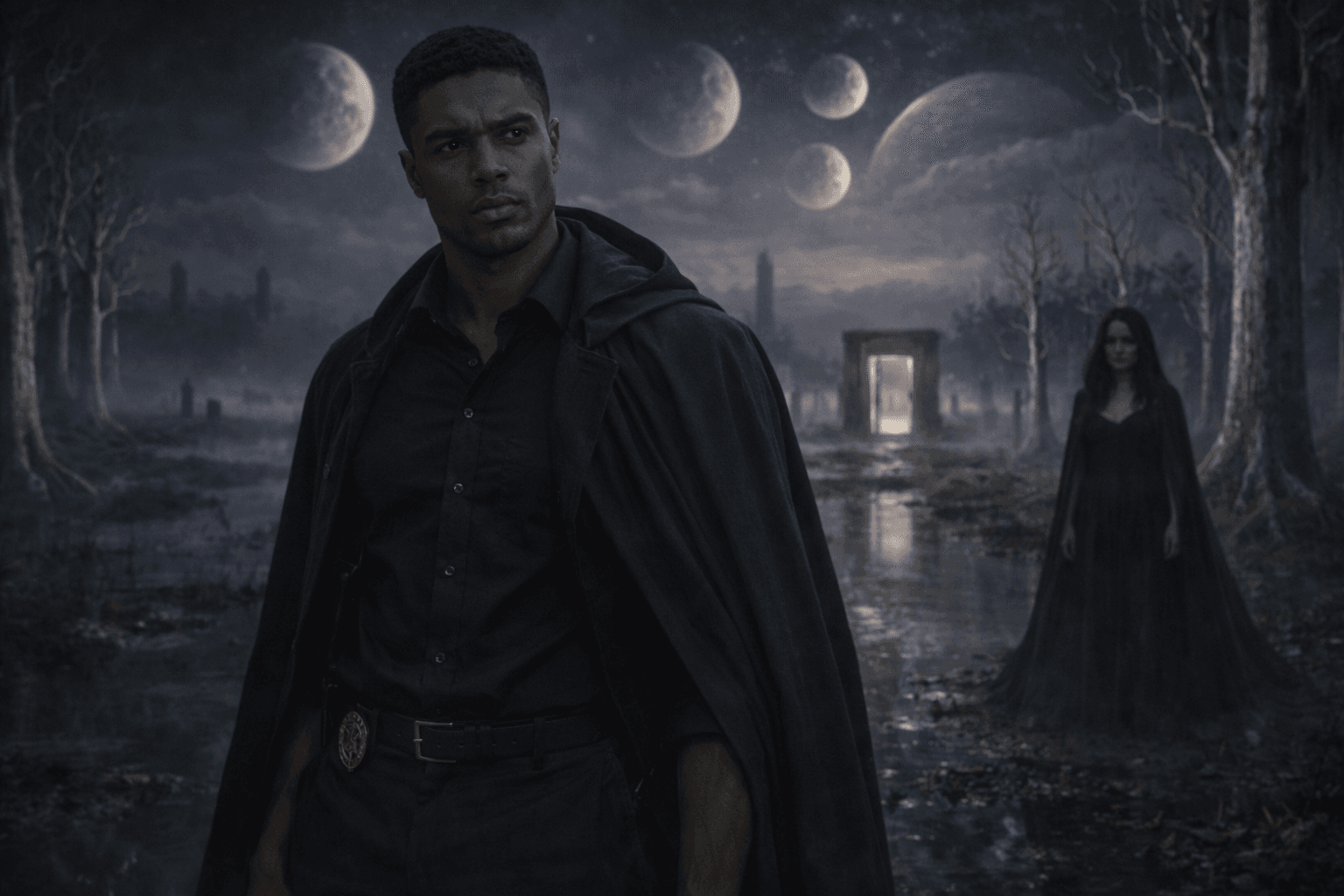
A deep, bruised violet stretched overhead, torn through with ribbons of green and silver light that drifted in slow, liquid waves across the horizon.
An aurora.
Except—
Auroras didn’t move like that.
And they didn’t hang beneath three moons.
The nearest was pale and cratered.
The second burned low and amber against the dark.
The third—
The third seemed to drink the light from the others.
Julian swallowed—
And tasted it again.
That faint metallic tang from the glass back at Belle Veil.
The memory slid into place with sudden, awful clarity.
The sweating condensation.
The way the room had bent at the edges.
The way time had begun to slip.
They’d put something in it.
He’d been drugged.
His gaze shot back up to the impossible sky—to the aurora bleeding across three swollen moons, to the pale trees rising out of black water like bone from the marsh below.
This could be a hallucination.
It would make sense.
Wouldn’t it?
A man with no sleep, dosed at a party by a suspect he couldn’t yet prove—wandering off into the cemetery and dreaming up another world to explain what he’d seen.
His pulse hammered.
He needed it to be that simple.
Margaret moved ahead without looking back.
Her bare feet didn’t sink into the damp soil.
Julian followed at a distance, every step feeling less certain than the one before it.
She led him toward a rise of stone at the center of the marsh—a circle of standing pillars half-swallowed by time and growth. Each one was carved with the same interlocking runes he’d seen beneath Belle Veil, their surfaces lit faintly from within by that same amber-white glow.
Ancient.
Waiting.
Figures stood within the circle.
Men.
Women.
Beautiful in a way that stirred an instinct he couldn’t name—and didn’t trust.
Their skin was pale as riverstone beneath the aurora light. Their robes hung loose from narrow shoulders, shifting in colors he couldn’t quite name—blacks that bled into violet, silvers that caught the glow of the moons.
They turned as Margaret approached.
Their eyes—
He stopped.
Their eyes reflected the sky like polished glass.
“How is that possible…” he whispered, though he wasn’t sure if the words made it past his teeth.
Margaret stepped into the circle and lifted her hands.
“It is time,” she said, her voice carrying farther than it should have in the open air. “The solstice has come. A feast awaits us—an offering in honor of our queen. They believe us to be gods, that their lands will be blessed for what they’ve given this night.”
A murmur passed through them—
Then a sound.
Soft at first.
Then rising.
A song.
Low and rhythmic, the words moving through a language Julian didn’t know but felt somewhere in the back of his teeth.
A name repeated—
Again.
And again.
“Avalaria…”
“Avalaria Darkbloom…”
Their Queen.
Their voices swelled beneath the bleeding light of the sky until the very air seemed to hum with it.
Then—
As one—
They turned.
And began to walk.
Back toward the stone wall where the Door had opened.
Julian’s throat went dry.
They were going back.
Back to Belle Veil.
Back to Saint Brigitte.
Back to feed on Crowley’s guests.
His mind scrambled for something human—something explainable.
Cannibals?
Or something worse?
He slipped behind one of the pale-barked trees.
They were close now—close enough for the aurora to wash the color from their skin until it gleamed pale as bone. Their eyes caught the strange light and held it, luminous in a way no human eye should be. One of them smiled as they passed, and Julian caught the briefest glint of something too long, too sharp to belong behind human lips.
For a heartbeat, his mind reached for a word—and recoiled from it just as quickly.
That was superstition. Folklore. The kind of stories whispered to keep children from wandering too far into the dark.
And yet—
He could not shake the certainty that whatever walked ahead of him now had stepped straight out of something older than reason.
One by one—
They disappeared through the now-open doorway.
Julian moved closer, keeping to the shadow cast by the standing stones.
Just one more step—
Then another—
“Going somewhere, Agent Cross?”