What The Swamp Remembers ~ Part 2
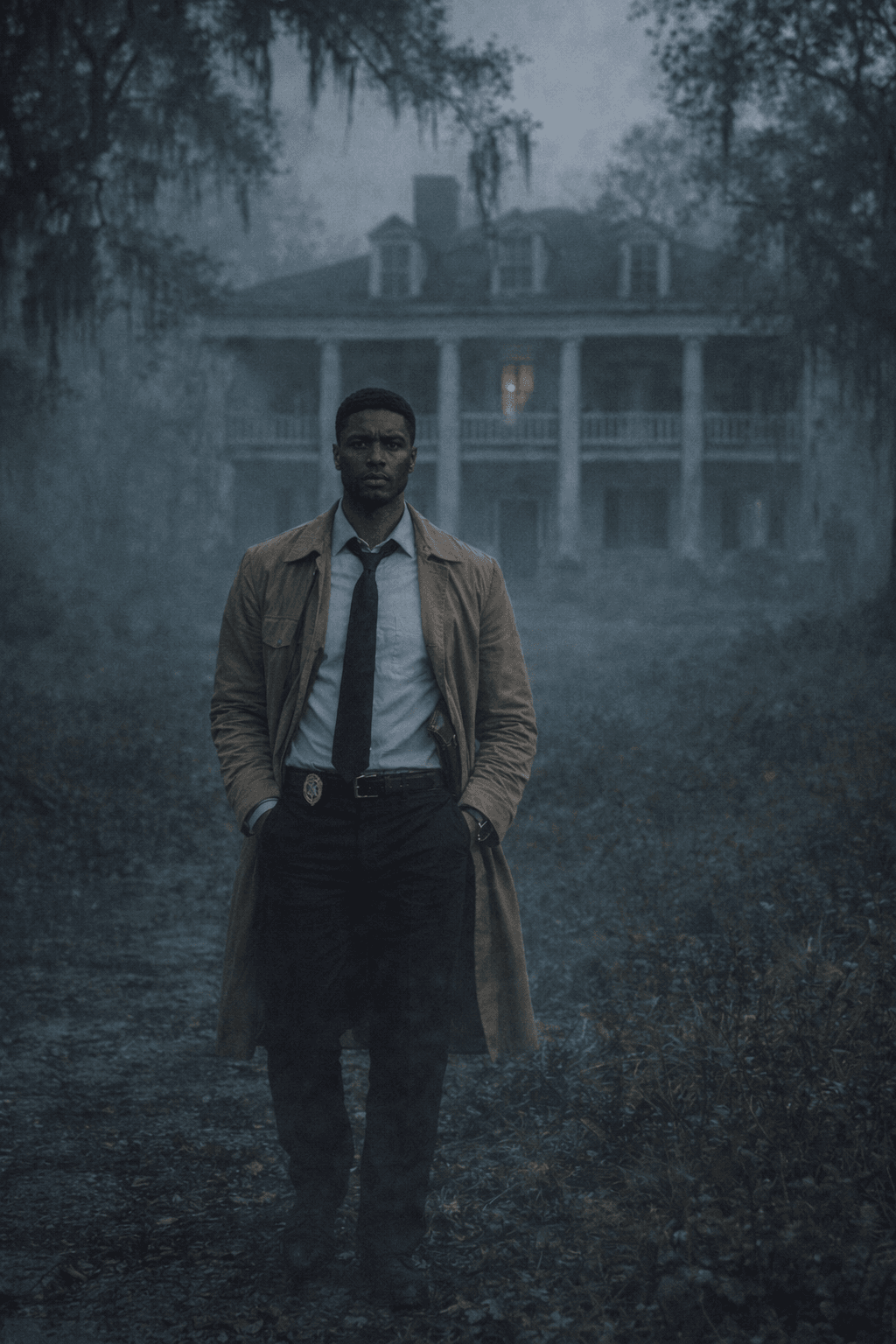
Julian drove with one hand loose on the wheel, the other resting against the door as the road narrowed and the trees began to close in on both sides. The tires hummed steadily beneath him, a low, constant sound that should have been calming.
It wasn’t.
Scenes from the evidence trailer replayed in his mind whether he wanted them to or not. Faces pinned to the board. Red string pulled tight between names. Dates scrawled in hurried ink. The sheriff’s voice. The smell of stale paper and overheated lights.
The noise in his head was loud. Overlapping. Blurred.
But it was still better than the other thought.
The one that kept trying to push its way forward.
Julian, you were born in Saint Brigitte Parish… at Belle Veil Plantation.
His friend’s voice had been thin over the line, crackling with static, but the words had landed clean. Too clean.
Then the other image.
The side of the rental house.
The white siding streaked dark.
The careful letters pressed into drying blood.
GO HOME.
He tightened his grip on the wheel.
What did it mean?
Was it really meant for him?
Or was he just reaching for something that wasn’t there, letting coincidence stitch together a story because the timing felt too perfect?
People were good at that. Seeing patterns where there weren’t any.
He let out a slow breath.
You’re overthinking it.
That was all this was. A case. A bad one. The kind that got handed to agents who’d made mistakes and needed reminding they weren’t untouchable.
He had a job to do.
He’d do it.
And then he’d get the hell out of Saint Brigitte Parish and back to New Orleans where things made sense again.
The swamp pressed closer the farther he went.
Water flashed through the trees in quick silver glimpses. Moss hung low, thick enough in places to swallow the light. The air felt heavier out here, like the land had been breathing for a long time without ever fully exhaling.
Every mile he drove brought him closer to one place.
Belle Veil Plantation.
The name had settled into him like a stone dropped into deep water, the ripple still moving outward long after the sound had faded.
He replayed the evidence board in his mind.
Fourteen dead.
Eight still missing.
Every name tied back to the same place.
A bartender who’d worked a private event there.
A landscaper hired to clear the grounds.
A girl who’d gone to one of the parties and never came home.
A man last seen walking the road that cut past the property line.
And the bodies…
Every one of them had attended at least one of the gatherings.
Wild parties.
Music that carried through the trees late into the night.
Cars lined up along the road for miles.
People coming in from Baton Rouge. New Orleans. Even out of state.
No permits. No oversight.
Just lights burning across the old plantation grounds and strangers drifting in and out like they already belonged there.
What in the world could pull that many people to one place?
Julian had worked enough cases to recognize a pattern when he saw one.
And this one wasn’t subtle.
It wasn’t random.
It was contained.
The road curved, and for the first time, the trees thinned enough for him to see it.
Belle Veil.
Sitting low and wide against the swamp, its dark shape stretching across the land like it had been there longer than anything else around it. Watching. Waiting.
Julian felt something move through him then.
Not fear.
Something quieter. Heavier.
Recognition.
For the briefest second, it felt like memory — the kind you can’t place but swear you’ve felt before.
He swallowed and shook his head hard, like he could knock the thought loose.
“Cut it out,” he muttered under his breath. “You’re just imagining things.”
This wasn’t destiny.
This wasn’t fate.
And it damn sure wasn’t personal.
“It doesn’t matter that you were born here,” he said quietly, more to himself than anything else. “This has nothing to do with that.”
His eyes stayed fixed on the plantation as it grew larger in the windshield.
“Do your job,” he said. “Then get out.”
But even as the words left his mouth, he couldn’t shake the feeling that he wasn’t driving toward the case.
He was driving toward something that had already been waiting for him.
____________________
Julian cut the engine and sat for a moment, listening as the metal ticked and settled into the quiet.
Up close, Belle Veil felt larger than it had from the road—not just in size, but in presence. The house stretched long and low across the property, its white columns stained by time, the porch sagging just enough to suggest it had been holding its breath for too many years. Moss clung to the roofline. Tall, narrow windows glowed faintly from within.
It had the look of something that had once been proud.
Now it simply endured.
Or watched.
He stepped out, gravel crunching underfoot, and started up the path. The air smelled of damp earth and something sweeter beneath it. Flowers, maybe. Something blooming late. But there was a sourness under that too, faint and persistent.
Rot under perfume.
He lifted his hand to knock.
Movement flickered at the edge of his vision.
To the left, near the side of the house, a man stood half-shadowed beneath the overhang. Late thirties, maybe. Tall. Broad through the shoulders. Dressed in worn work clothes that looked permanently stained by dirt and weather. A pair of pruning shears hung loose from one hand.
He hadn’t made a sound.
He was just there.
Watching.
There was something off about the stillness. Not just the way he stood, but the way he looked at Julian. No curiosity. No greeting. Just a steady, unblinking stare. His eyes were dark. Not just brown—dark enough that the color disappeared in the shade.
And beneath the quiet, something else moved.
Recognition.
Julian held his gaze a moment longer than he meant to. The man didn’t nod. Didn’t smile. Didn’t look away.
Then the front door opened.
“You must be Agent Cross.”
Julian turned.
Sebastian Crowley stood in the doorway, tall and narrow, his graying hair pulled back neatly, dressed in a silk shirt that probably cost more than Julian’s monthly rent. He smiled as if greeting an old friend instead of a federal agent.
“Sheriff called ahead,” Crowley said. “I was expecting you.”
Julian lowered his hand. “Mr. Crowley.”
“Please,” Crowley said lightly, stepping aside. “Sebastian.”
Julian gave the groundskeeper one last look before stepping inside.
The interior stopped him for just a second.
The bones of the house were unmistakably old—high ceilings, wide wooden floors, a sweeping staircase worn smooth by generations. The kind of craftsmanship that didn’t exist anymore.
But the rest of it…
It looked like the 1970s had crashed headfirst into the 1860s and never bothered to clean up the wreckage.
Burnt orange rugs layered over antique flooring. Heavy velvet drapes hanging beside original plantation shutters. Low, modern couches shoved awkwardly into rooms clearly built for something more formal. Brass lamps. Beaded curtains. Somewhere deeper in the house, a record player was still spinning, the needle scratching softly at the end of a song.
And the mess.
Empty glasses sat on every flat surface. Ashtrays overflowing. Bottles lined the hallway table. A scarf had been dropped over the banister and forgotten. The faint smell of smoke and alcohol lingered like the night hadn’t fully ended yet.
Crowley moved past him, gathering a few abandoned glasses as he went. He tossed them into a trash can near the entry with a casual flick of his wrist.
“Apologies,” he said. “Cleaners are running late. We had people here last night. Things got… lively.”
Julian’s eyes drifted to a side table.
A small tray sat there. A mirror. A razor blade. A thin white line that hadn’t been fully wiped away.
He looked back up at Crowley.
“You got any idea the kind of trouble a federal agent could cause you over something like that?” Julian asked evenly.
Crowley didn’t flinch. He gave a soft, almost amused laugh.
“I imagine quite a bit,” he said. “But I also imagine you’re not here for that.”
Julian held his gaze.
“Lucky for you,” he said, “we’ve got more pressing matters.”
Crowley nodded slowly. “Yes. The killings.”
The word landed strangely in his mouth. Not fearful. Not angry.
Almost reverent.
Julian took a few steps deeper into the house, his eyes adjusting, taking in details as he moved. Old portraits lined the walls. Original molding hid beneath layers of newer paint. The place couldn’t seem to decide what century it belonged to.
“You’ve been throwing a lot of parties,” Julian said.
Crowley smiled again, but this time it didn’t reach his eyes.
“I like people,” he said. “I like what happens when they gather. Energy builds. You can feel it in the air.”
Julian said nothing.
Crowley continued, his voice drifting, almost thoughtful now. “Places like this… they remember things. People bring life back into them. Music. Laughter. Celebration.” He glanced up toward the ceiling. “It wakes something up.”
Julian studied him.
“You believe that?” he asked.
Crowley turned back to him, completely serious now.
“I believe this land has always been sacred,” he said. “Long before any of us arrived. Before the house. Before the parish. Some places are meant for… devotion.”
Julian felt the word settle heavier than it should have.
“Devotion,” he repeated.
Crowley gave a small nod. “Call it religion. Call it ritual. People need something bigger than themselves to believe in. Something that connects them.”
Julian watched him carefully.
Yeah.
This guy was into weird stuff.
“People go missing after these parties,” Julian said, cutting through it. “You aware of that?”
Crowley’s smile faded, but only slightly.
“I’ve heard the rumors,” he said. “People always want to blame the loudest place in town.”
Julian stepped closer.
“Fourteen people are dead,” he said quietly. “Eight more are missing. And every single one of them was on this property at some point.”
Crowley didn’t move. Didn’t look away.
For just a moment, something darker flickered beneath the charm.
Then it was gone.
“Well,” Crowley said softly, turning to gather more empty glasses, “then I suppose you’d better find out why.”
He tossed them into the trash and didn’t look back.
“And since you don’t have anything to pin on me, Agent… I’d say our meeting is at an end.”
So much for the warm welcome.
“Indeed, this part of it is,” Julian said. “But I’ll be looking over the grounds now. And before you protest—” he reached into his jacket and held up the folded paper “—I do have a warrant issued by the sheriff’s office.”
Crowley rolled his eyes, the smile returning, thinner this time.
“Of course you do,” he said. “You won’t find anything.”
He stepped aside, gesturing toward the back of the house.
“But by all means… have at it.”
Moments later, Julian let the back door close softly behind him and stepped off the porch into the heat.
The air felt thicker here, away from the house. Less movement. Less sound.
He paused a moment, letting his eyes re-adjust to the sunlight, then started walking.
No clear direction. Just following the slope of the land as it dipped slightly away from the main yard. The grass thinned the farther he went, giving way to patches of bare earth and roots pushing up through the soil.
The house fell quiet behind him.
Even the music he’d heard earlier seemed to disappear once he reached the tree line.
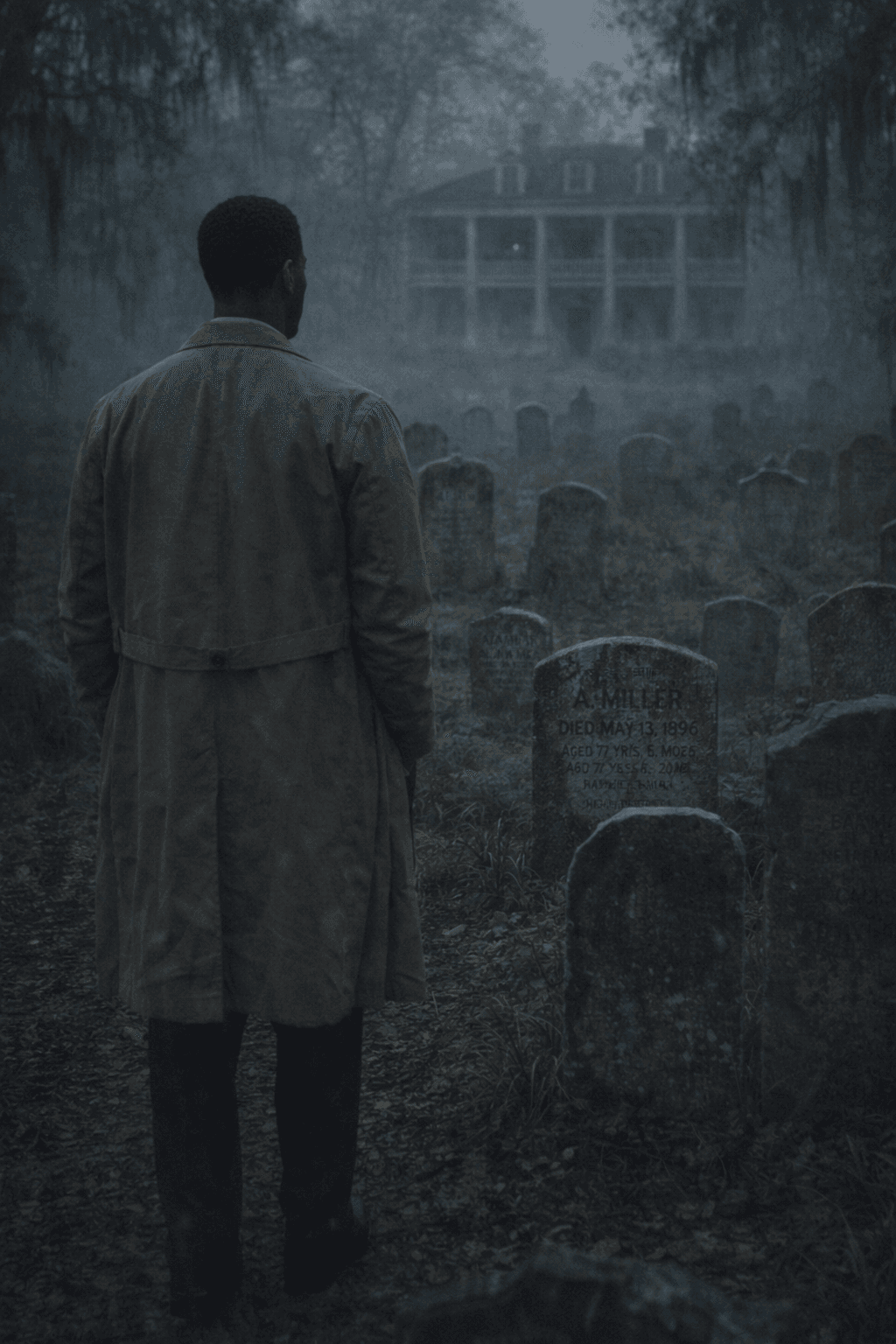
That was when he saw the first headstone.
It leaned at an angle, half-swallowed by the ground, its surface worn smooth by weather and time. A name had once been carved there. Now it was only a suggestion, the letters softened into shallow grooves that caught the light but refused to be read.
Julian slowed.
There were more.
A family cemetery.
Older than the house.
The headstones rose from the earth in uneven rows, some cracked, some broken, some so old they looked less like markers and more like part of the land itself. The grass thinned beneath his feet, giving way to damp soil that shifted slightly as he walked, soft enough that his shoes sank with each step.
He moved deeper in, scanning names where he could still read them. Dates from the late 1800s. Early 1900s. Entire families buried close together. Small stones mixed in among the larger ones.
Children.
He found himself scanning the stones without meaning to, searching for names he didn’t know, for dates that might line up with something half-remembered.
His mother.
The thought came uninvited.
If she had lived here… if she had died here…
Would they have buried her among them?
Julian paused, eyes moving slowly over the worn markers, the ones with names still visible, the ones that had been taken back by time.
Almost without meaning to, he followed the slope of the land inward, deeper into the cemetery, until the graves thinned and the ground dipped slightly ahead.
At first, it didn’t look like anything at all.
Just a rise in the earth where the grass grew thinner, the soil darker. Then the shape revealed itself — a stone arch set into the side of the low embankment, half-swallowed by time and creeping roots.
A doorway.
Not to a building, but into the ground.
The frame was made of dark, weathered stone, carved with a kind of care that felt out of place this far from the house. It had the quiet, deliberate look of something built to last — something meant to protect what lay beneath it.
An underground mausoleum.
There was no grand structure above it, no columns or roof reaching toward the sky. Just that regal, heavy doorway set into the earth, as if generations had been laid to rest below rather than above.
The stone had sunk slightly over the years, the edges softened by weather and moss, but the entrance still held its shape — patient and waiting.
And it was wrong.
He felt that before he could explain it.
The door stood slightly ajar.
Not wide. Just enough to show the line where darkness began.
The lock hung loose and rusted, snapped clean at the hinge. The stone around the entrance was marked by fresh scuffs, the dirt near the threshold disturbed like something had been dragged across it not long ago.
He stopped a few feet from the opening.
There was a faint smell coming from inside. Not decay. Not exactly.
Something older.
He glanced back toward the house.
It sat quiet and distant through the trees, its windows reflecting the late afternoon light.
Too far away to hear anything.
Too far away to help.
Julian turned back to the mausoleum and leaned slightly, just enough to look through the narrow opening.
Darkness swallowed everything past the threshold.
But there were steps.
Stone.
Leading down.
And for just a second — so faint he couldn’t be sure — he thought he heard something move below.
Not a voice.
Not a footstep.
Just the softest shift of air from somewhere deep beneath the earth.
Julian stood there a long moment, staring into it.
Something about the place felt familiar in a way he didn’t like.
Like he’d been standing at this doorway once before.
And just didn’t remember it.
He should have turned back.
He knew that. Felt it, somewhere deep and insistent. The kind of instinct that had kept him alive in bad situations more than once.
Instead, he stepped forward.
The iron door gave easily beneath his hand, opening just enough for him to slip inside. The air changed the moment he crossed the threshold—cooler, heavier, thick with the smell of old stone and damp decay. The light behind him fell short of the interior, and for a moment he stood there, letting his eyes adjust to the dim.
Stone steps descended into the earth.
He moved carefully, one hand trailing along the wall, feeling the rough surface beneath his fingers as he made his way down. Each step seemed to swallow the sound of his movement. Even his breathing felt too loud in the narrow space.
At the bottom, the passage opened into a small chamber.
And at the far end, set into the back wall, was a door.
Carved directly into the stone, framed by patterns that didn’t match anything else in the mausoleum. The lines were intricate, deliberate, curling into shapes and symbols that didn’t feel religious, didn’t feel decorative. They felt older. Older than the house. Older than the graves above.
Julian stepped closer without meaning to.
He stopped a few feet from the doorway, studying the carvings. His mind tried to make sense of them, to place them somewhere familiar, but they slipped away the moment he thought he recognized a pattern.
Then, slowly, the runes began to glow.
At first he thought it was a trick of the light. A reflection. Something shifting behind him.
But there was no light behind him.
The symbols along the frame of the doorway shimmered faintly, a soft, pulsing glow moving through the carved lines like breath through lungs. Not bright. Just enough to be seen.
Julian felt it before he could name it—a faint hum beneath his skin, and a strange warmth hanging in the air, as if the space itself was breathing.
He took another step.
The warmth grew stronger, rising up from the stone floor, from the walls, from the doorway itself. It settled into his chest, into his bones, like something recognizing something.
Like something answering.
Without thinking, he reached out.
His fingertips brushed the stone.
The moment he touched it, something moved through him.
Not pain.
Not exactly.
Power.
It surged up his arm, sharp and electric, flooding his chest, his head, his lungs. His breath caught hard in his throat. For a split second he saw—
Light. Darkness. Shapes that didn’t belong to this world. A landscape that felt impossibly far and terrifyingly close.
And then—
Something struck the back of his head.
Hard.
White exploded across his vision. His knees buckled. The stone rushed up to meet him as the world tilted sideways.
The last thing he felt was the warmth of the doorway still humming beneath his palm.
Then everything went black.
____________________
Julian came back slowly.
Sound first. Voices somewhere above him. The low rustle of leaves shifting in a faint breeze.
Then the pain.
It spread from the back of his head forward, dull and steady, like something had been ringing inside his skull for a long time and hadn’t quite stopped.
“Easy now.”
The sheriff’s voice. Close. Firm.
Julian opened his eyes. The light above him was too bright at first, broken into fragments by moving shadows. He was on his back, the cool earth pressed against his shoulders, the scent of damp soil thick in his lungs.
Sheriff Thibodeaux was kneeling beside him, one hand hovering uncertainly near his arm as if she couldn’t decide whether to help him sit up or keep him still.
“Can you hear me?” she asked, leaning in slightly. “Agent Cross, stay with me now.”
He swallowed. His throat felt dry. “Yeah.”
The word scraped its way out.
She let out a breath, relief breaking through the tight set of her mouth. “You gave me a scare. We found you laid out down here, not moving. Thought I might have to call this in.”
We found you.
Julian blinked, trying to clear the fog. He’d been alone when he went into the mausoleum. No one had followed him down. He was sure of that. So how long had he been out… and when had the sheriff gotten there?
He tried to push himself up. The world tilted, and a sharp spark of pain flared behind his eyes. He stopped, breathing through it, one hand instinctively going to the back of his head.
Behind her, he saw them.
The groundskeeper stood a few feet back, half in shadow, arms at his sides. Still as stone. Watching in that same quiet way that made Julian’s skin itch. His dark eyes didn’t move, didn’t blink.
And next to him—
Margaret.
The church woman from the night before. The one who had brought him dinner. Dinner he hadn’t touched. Still sitting in the fridge back at the rental, exactly where he’d left it.
She stepped forward the moment she saw his eyes find hers.
Concern softened her face as she knelt carefully near his shoulder, close enough that he could see the worry there, but not crowding him.
“You gave us quite a scare,” she said gently. “The sheriff came to check on you and found you down here alone.”
Julian’s gaze drifted past them, toward the mausoleum.
The door was shut now.
Tight.
Sealed like it had never been open at all.
His brow furrowed.
How had he gotten back out here?
He’d been inside. Standing at the bottom of the steps. In front of that carved doorway. He remembered the runes. The warmth. The way the air had changed.
And then—
The blow.
Something hard had crashed into the back of his skull.
None of this made sense.
“What happened?” the sheriff asked, her tone steady but searching. “Did you trip on those steps? Place is uneven down there. I’ve been meaning to have someone take a look at it.”
Julian hesitated.
“I must’ve slipped,” he said finally.
The lie came easier than the truth he couldn’t explain.
Sheriff Thibodeaux studied him for a moment, like she was weighing whether to push, then gave a small nod. “Wouldn’t be the first time someone’s taken a spill out here. You’re lucky you didn’t crack your skull open.”
Margaret reached out then, her hand settling lightly against his shoulder, steadying him.
The touch was warm.
Grounding.
“You hit your head pretty hard,” she said softly. “You should let the sheriff take you into town. Get it looked at. Concussions can sneak up on you.”
Julian shook his head, slower this time. “I’m fine. I’ve had worse.”
The sheriff raised an eyebrow. “That doesn’t mean you should ignore it.”
“I won’t,” he said. “Just need a minute.”
But he didn’t pull away from Margaret’s hand.
There was something about her presence that cut through the fog in his mind. The pounding in his head felt more distant when she was close. The air didn’t feel so heavy.
For a moment, the darkness below the stone faded. The humming warmth. The flash of light. The feeling that something had moved through him.
All of it drifted back, replaced by the sound of her voice.
“Take it easy,” she said. “You’re safe.”
Julian looked at her, really looked this time.
He couldn’t have said exactly how old she was—five, maybe six years older than him. But there was a calmness about her that felt steadying. Her dark hair fell loose around her shoulders, catching the light in soft waves. Her eyes were a deep green, steady and kind.
And her voice…
Low. Musical. Comforting.
Like something meant to soothe.
Like some part of him had been waiting to hear it.
He felt himself settle without meaning to.
Drawn in.
And then he caught himself.
What are you doing?
The thought snapped through the haze like a match struck in the dark.
He looked away from her, clearing his throat, forcing himself to sit up straighter. His head throbbed, the pain grounding him again.
You’re here to work.
Not to get distracted.
He pressed his palm against the back of his neck, wincing slightly.
Shake it off.
She was just a woman who’d shown kindness. Nothing more. Nothing less.
Sheriff Thibodeaux rose to her feet, brushing dirt from her hands. “That’s enough for today,” she said, her tone firm but not unkind. “You took a hard hit. No more work and no more driving until tomorrow. I’m not arguing about it.”
Julian pushed himself a little straighter, testing his balance. The ground didn’t tilt this time, but the ache in the back of his head throbbed in warning.
“I can drive,” he said automatically.
She shot him a look that stopped him cold.
“No, you can’t,” she said. “Not with that head. You’ll get halfway down the road and wrap yourself around a tree. Then I’ve got two problems instead of one.”
Julian exhaled through his nose, already preparing to argue.
She turned slightly, glancing toward Margaret. “Margaret, would you mind driving him back to the rental? I’ll have one of my deputies swing by later and pick up his car.”
Julian shook his head. “That’s not necessary. I don’t need a ride.”
Margaret stepped in gently before the sheriff could respond.
“It’s alright,” she said. “I’ve got my car here. I can take him back. It’s not out of my way. I have to go back to the church anyway.”
Sheriff Thibodeaux nodded, already satisfied with the solution. “That works. I’ll have a deputy come out later and bring your car back into town, Julian. That’s one less thing for you to have to worry about.”
Julian hesitated, glancing back toward where he’d parked, the dull throb in his skull reminding him he wasn’t as steady as he wanted to be.
“I don’t like the idea of leaving it here,” he said.
“It’ll be fine,” the sheriff replied. “I won’t let it sit here for long. It’ll be back at your place before you go to bed.”
Margaret gave him a small, reassuring smile. “Come on. I’ll get you home quick.”
Julian studied her for a second, weighing it, then gave a short nod.
“Alright,” he said. “I guess I have no choice..."
—
The drive back was quiet.
Julian sat in the passenger seat of Margaret’s car, one arm resting against the door, the other pressed lightly to the back of his head. Margaret drove carefully, steady hands on the wheel, the road unspooling slowly ahead of them through the darkening trees.
“You sure you’re alright?” she asked after a while, her voice soft but steady over the low hum of the engine.
Julian shifted slightly in the seat, one hand resting against the back of his head. “I’ve taken worse spills than that,” he said. “Comes with the job.”
Margaret glanced over at him, then back to the road. “That’s what you keep saying.”
He gave a small shrug. “Because it’s true.”
She was quiet for a moment, fingers adjusting lightly on the steering wheel. “Maybe,” she said finally. “Or maybe it’s just easier to say that than to admit when something actually shook you.”
Julian let out a breath through his nose, not quite a laugh. “You always this good at reading people?”
“Sometimes,” she said. “Especially when I get the feeling there’s more someone isn’t saying.”
He turned his head slightly, studying her profile. “And you think that’s what this is?”
“I think you walked into that cemetery alone,” she said gently, “and whatever happened in there… it wasn’t just a slip in the mud."
Julian looked back out the windshield, watching the dark ribbon of road unwind ahead of them.
“I’m fine,” he said after a moment. “Really.”
She didn’t push.
Just nodded once, like she understood the difference between someone who wouldn’t talk and someone who couldn’t.
He glanced at her, then back at the road. “You come out here often? After the parties?”
“Sometimes,” she said. “When Sebastian asks. It’s a lot for one person to handle. Glasses, trash, putting things back where they belong.” She shrugged slightly. “The church doesn’t pay much. Every little bit helps.”
Julian nodded, filing it away without meaning to.
“And you just happened to get there when the sheriff found me?” he asked, casual, almost offhand.
Margaret kept her eyes on the road. “I’d just pulled up. I heard her calling your name. I followed the sound.”
Something about the timing felt… neat.
But Julian let it go.
His head hurt. The world felt slightly out of focus. And there was something about her presence beside him that made it easier not to dig.
“Good thing you did,” he said.
She glanced over, her expression gentle. “I’m glad I was there.”
—
By the time they reached the rental house, the sky had gone fully dark.
Margaret pulled into the drive and cut the engine.
“Do you want me to walk you in?” she asked.
“I’ve got it,” Julian said, managing a small nod. “Thank you. For the ride.”
“Get some rest,” she said. “You need it.”
He stepped out, the night air cooler now, the ache in his head pulsing steadily as he climbed the porch steps.
The porch light was already on.
He didn’t remember leaving it that way.
He unlocked the door and stepped inside.
The house was still. Just the faint hum of the refrigerator and the distant sound of insects outside.
Then he saw it.
Something sat on the small kitchen table.
It hadn’t been there when he left.
Julian moved closer, slow, cautious, his eyes sweeping the room on instinct. No signs of forced entry. No broken locks. No open windows.
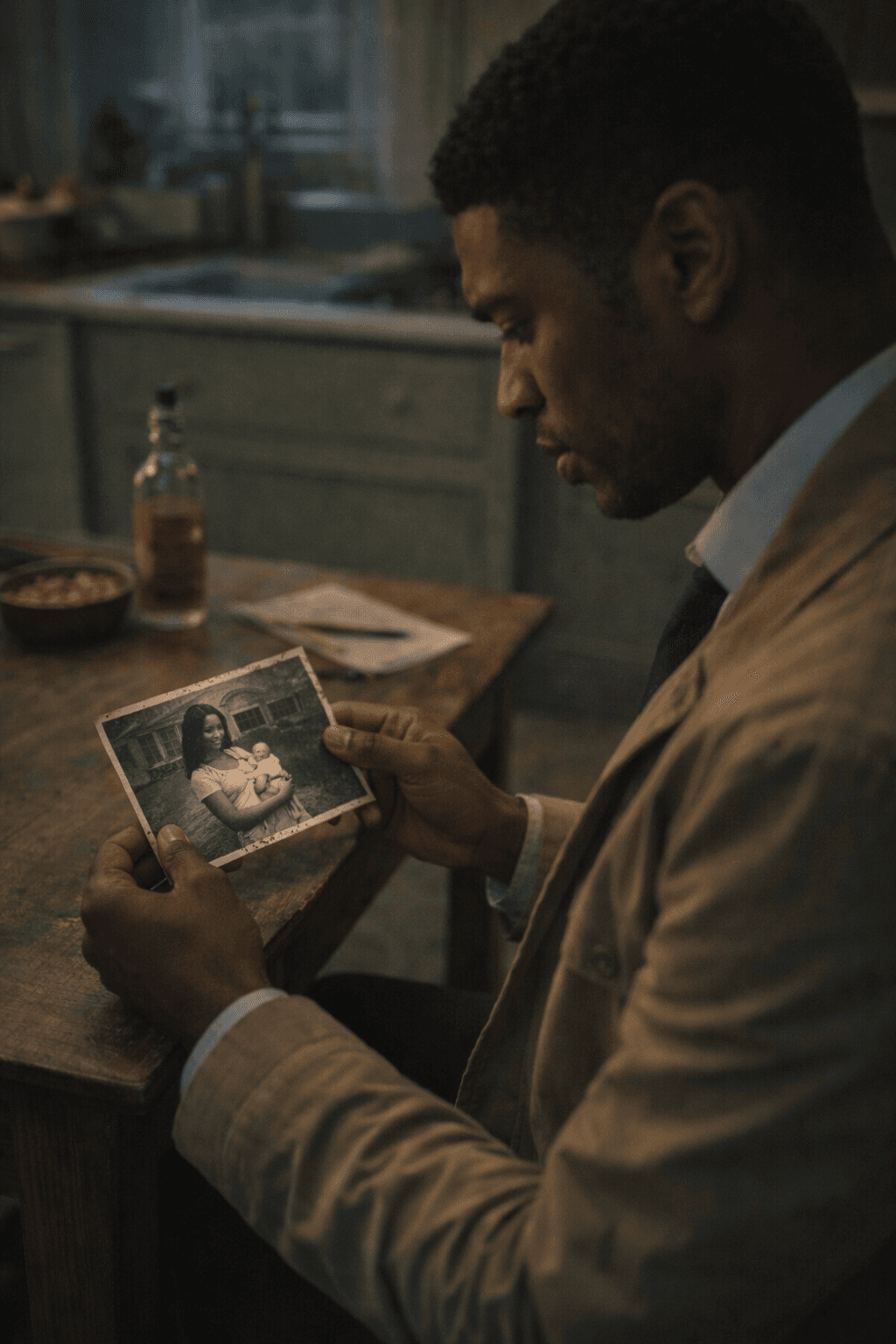
Just the photograph.
Old. The edges worn and curled. Black and white.
He picked it up carefully.
A young woman stood in front of a large house he recognized immediately, even through the grain and fading.
Belle Veil.
She was smiling faintly, one arm wrapped protectively around a baby held in her arms.
Julian’s breath caught.
He turned the photograph over.
Written in careful, looping script:
Eliza Broussard — Belle Veil Plantation, 1948
Without being told, he knew this was his mother. And the baby she was holding in her arms was him.
He stood there, the photo trembling slightly in his hand, the quiet of the house suddenly too loud.
No one knew her name.
He hadn’t told the sheriff.
He hadn’t told Crowley.
He hadn’t told Margaret.
He hadn’t even known her last name himself until now.
The message on the side of the house rose in his mind again, dark and deliberate.
GO HOME.
Julian stared down at the photograph.
Someone had been inside his house.
And they knew exactly who he was.