What The Swamp Remembers ~ Part 1
1983 ~ Louisiana
Julian had never seen anything like this. Not in photographs. Not in case files.
The body—what remained of it—was arranged across the makeshift altar like something broken and discarded, limbs slack, flesh torn open with a violence that felt intimate. Her throat had been ripped out. Her ribcage split wide, bone cracked and pried apart. Whatever had taken her had done so thoroughly, reverently, leaving absence where her organs should have been. Too much damage. Too deliberate.
And yet her face had been spared.
Untouched. Almost peaceful.
Two smooth gray stones had been placed carefully where her eyes should have been, their surfaces worn soft by water and time. On each stone, amethyst eyes had been painted wide and unblinking, the violet pigment catching the thin, gray light filtering down through the canopy. They stared upward through the tangled vines and hanging moss, fixed and watchful, as if she had been arranged to see something long after her body had been ruined.
As if sight, here, had nothing to do with being alive.
The flies wouldn’t land on the stones.
They swarmed her torn throat, the split of her ribs, the wet absence beneath—but they skirted the stones entirely, veering away as if repelled. Even the ants traced careful paths around them. The swamp accepted the rest of her without hesitation. Just not that.
Julian felt his jaw tighten.
He’d seen violence before. Gunshots, knives, blunt force—men killing fast, sloppy, or desperate. He’d stood over bodies that told clear stories if you knew how to read them. Rage. Fear. Opportunity. This wasn’t that.
This was work.
Whatever had done this hadn’t rushed. It hadn’t panicked. There was no frenzy here—only selection. Intention. The kind of care that made his skin prickle beneath his damp shirt and the collar of his jacket feel too tight despite the heat.
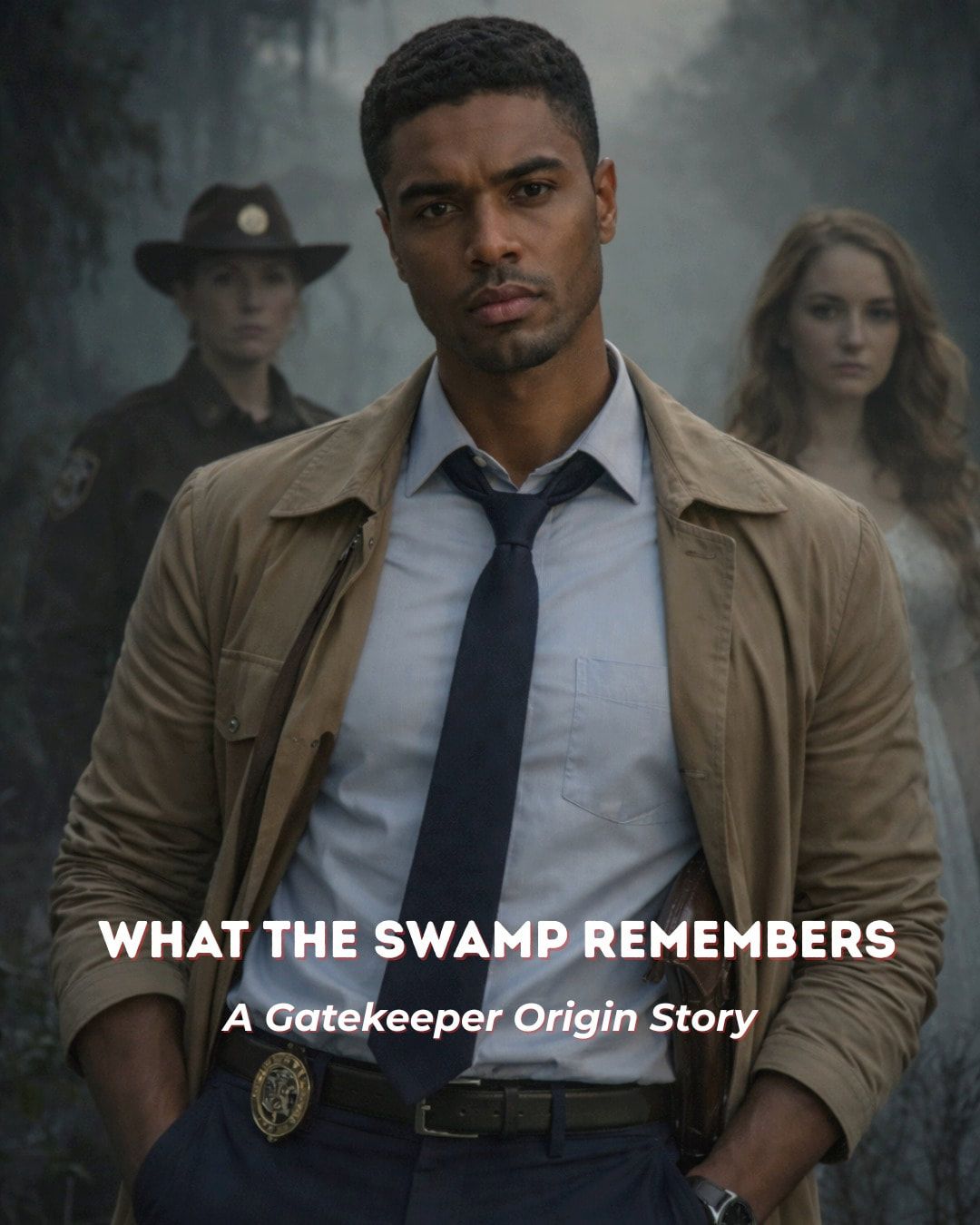
He adjusted his tie out of habit, even though sweat had already soaked through the cotton and the swamp air made the gesture pointless. Thirty-five years old, badge still in his pocket, reputation hanging by a thinner thread than anyone here knew—and standing in a parish that smelled like rot and incense.
The stones stared back at him.
Julian had the unsettling thought that this wasn’t meant for the girl at all.
It was meant for whoever found her.
Boots sank softly into the mud behind him.
Julian didn’t turn right away. He didn’t need to. He’d learned the difference between a man approaching to posture and someone who’d already decided where they stood. This was the latter.
“Agent Cross.”
Her voice was steady. Not sharp. Not apologetic either.
He turned then.
The woman standing a few feet back wore a pressed tan uniform darkened at the hems with swamp water. Sheriff’s star pinned over her left breast. Brown hair pulled back tight at the nape of her neck, no makeup to speak of, lines at the corners of her eyes that suggested she’d stopped being surprised by most things a long time ago.
“Sheriff Evelyn Thibodeaux,” she said, extending a hand that was dry despite the heat. “Welcome to Saint Brigitte Parish.”
He shook it. Her grip was firm. Assessed. She was taking inventory of him the same way he’d already done to her.
She glanced once—just once—at the body on the altar. Didn’t flinch.
“This makes thirteen,” she continued, matter-of-fact. “In six months.”
Julian’s brows drew together slightly.
“And that’s just the ones we’ve found,” she added. “We ain’t even gotten to the missing yet.”
She let that sit between them, heavy as the air.
Behind her, deputies stood too far back, hats low, eyes anywhere but the stones. The swamp hummed around them like it always had, unconcerned.
Sheriff Thibodeaux looked back at Julian.
“We’re past the point of pretending this is coincidence,” she said. “And past the point of handling it ourselves.”
A pause.
“So I hope you’re better than the last man who tried to make sense of this place.”
She didn’t smile when she said it.
After a while, the deputies started to shift. Not away from the body—away from him. Julian felt it without looking. The moment when locals decided the stranger had seen enough.
He wiped his hands on a handkerchief he’d already written off as ruined and shifted his weight, the quiet protest in his knees easy to ignore.
“Photographs taken?” he asked.
One of the deputies nodded too quickly. Another avoided his eyes. Film cameras. Flashbulbs. The sharp, chemical smell of documentation mixing with swamp rot and blood. Julian watched them work, noting angles, distances, the way the altar had been assembled with care rather than speed. He said very little. Let them talk themselves into revealing habits.
He crouched down—not to look at the body again, but at the ground around it. Boot prints. Bare footprints. Drag marks that stopped too cleanly. The swamp should’ve erased more than it had.
It hadn’t.
He marked the perimeter with his eyes, not tape. Tape was for people pretending control. He wanted to know what didn’t move when it should have.
When he finally stepped back, Sheriff Thibodeaux was already there, notebook tucked under her arm like she’d been born with it.
“I’ll need copies of everything,” Julian said. “Photos. Statements. Prior reports. Autopsies—if you’ve got them.”
Her mouth twitched. “We got a coroner. Closest thing.”
“I’ll take what you have.”
She studied him for a beat. Long enough to decide whether he was worth the trouble. Whatever conclusion she came to, she nodded.
“There’s a trailer we’re using as a command post. Generator works when it wants to.”
“That’ll do.”
Before leaving, Julian glanced back at the altar one last time, committing the details to memory. His attention settled on the stones again—their placement, the painted eyes. He’d worked enough scenes to know that details like that weren’t left by chance. Killers always left a mark. This one had placed theirs carefully.
He told himself to hold the details for later. That was what reports were for. Memory could be shaped. Paper couldn’t.
Sheriff Thibodeaux was already walking toward her cruiser. She stopped once, turned, and gave him a short nod. “Follow me back to the station.”
Julian watched her pull onto the road before getting into his own car.
The drive into town was quiet. No radio chatter. No sirens. Just the low whine of insects and the steady slap of tires against damp pavement. Cypress trees leaned in close, their branches threading together overhead until the sky narrowed to a thin gray ribbon. Julian kept one hand on the wheel, the other resting near his jacket pocket out of habit. The badge felt heavier there than it should have.
The sheriff’s office was a squat concrete building set back from the road, its windows darkened, its presence more practical than reassuring. Inside, it smelled faintly of old coffee and mildew.
Julian signed in. Logged his arrival. Established jurisdiction.
Every box he checked felt like a small act of defiance against what he’d just seen.
He took statements at a battered metal desk. Listened more than he spoke. Let silences stretch until people rushed to fill them with explanations that sounded rehearsed even to themselves.
Every version of the story was almost the same.
That was what bothered him.
By the time he was done, the sun was slipping low, turning the swamp outside the windows the color of old bruises. His shirt clung to him, damp with sweat. He loosened his tie, then retightened it again. Old habits died hard.
Sheriff Thibodeaux watched him from her doorway.
“You got a place to stay?” she asked.
“For now.”
She nodded. “If you need anything, you call.”
Julian met her eyes. “I will.”
It wasn’t a promise. It was procedure.
As he stepped back outside, the air felt thicker. Not heavier--closer. Like the town had drawn in a breath.
He told himself he’d earned a shower. A meal. A few hours of sleep before morning.
But as he headed toward the house he’d been assigned, Julian couldn’t shake the certainty that whatever had arranged the girl on that altar wasn’t finished.
It had been seen.
And that, here, meant something.
____________________
The house sat back from the road, lifted on short piers, its paint the tired white of something that had been touched up too many times. A single porch light burned, already attracting insects in a frantic halo. It belonged to the parish—one of those properties meant for visiting clergy once, before money got tight. Now it was rented when it had to be, and for now, it was his.
Julian cut the engine and sat for a moment, listening.
No crickets.
That struck him as wrong. Even in places this quiet, something usually made noise.
He got out, grabbed his bag, and climbed the steps. The boards creaked under his weight—not loud, just enough to announce him. Inside, the air was cooler than outside but damp, clinging to his skin. Someone had opened the windows. Someone had aired the place out.
The furnishings were sparse and modest. A small table. Two chairs. A sofa that looked like it had never been sat on long enough to remember a body. A crucifix hung in the hallway—not new, not old enough to be antique. Just there.
Julian set his bag down and loosened his tie for good this time. His reflection in the hallway mirror looked thinner than he remembered. Drawn. Like the day had taken something out of him he hadn’t agreed to give.
He was halfway through checking the door one final time before showering when there was a knock.
Julian paused, hand still on the knob. He checked his watch. Who would be stopping by at nearly nine o’clock at night?
He opened the door.
A woman stood on the porch holding a small cardboard box tied with twine.
She looked to be in her early forties, maybe a little older—hard to tell. Tall and thin with black hair pulled back simply. No makeup. High cheek bones. Defined features. A light cardigan despite the heat. She smiled the way people did when they were used to being received.
“I’m sorry to bother you,” she said. Her voice was calm, low. “Sheriff Thibodeaux said you’d be settling in tonight.”
Julian nodded once.
“I’m with the parish,” she continued, lifting the box slightly. “We try to make sure visitors don’t go hungry their first night. It’s nothing fancy.”
He hesitated, then stepped aside. Habit again. He didn’t like being rude. Didn’t like refusing kindness when it was offered cleanly.
“Thank you,” he said. “That wasn’t necessary.”
She smiled, already stepping inside. “Around here, it is.”
She set the box on the table and untied the string with practiced ease. Inside was a plate wrapped in foil, still warm. Something fried. Something sweet. The smell cut through the damp air immediately.
“I’m Margaret,” she said. “I help Father Lucien over at Our Lady of the Mire—church records, funerals… anything the parish needs handled.”
Julian nodded, his smile automatic. He’d never had much patience for small talk after a day like this.
“I won’t keep you,” Margaret said. “I know it’s been a long day.”
Her eyes flicked—just briefly—down the hallway, toward the crucifix. Then back to him.
“If you need anything,” she added, “the church is always open.”
She moved toward the door, pausing only once.
“Oh,” she said, almost as an afterthought. “You might hear things at night. The swamp carries sound strangely. Don’t let it trouble you.”
Julian watched her step back onto the porch, the insects parting around her without settling.
“Good night, Agent Cross.”
She didn’t wait for a response.
When the door closed, the house felt smaller.
Julian stood there for a long moment, staring at the box on the table.
The food was still warm, but suddenly Julian had no appetite. The image of the girl’s body—split open, arranged with care—kept pushing its way back into his thoughts. Hunger didn’t stand a chance against that.
He didn’t unwrap the foil. He simply closed the lid back over the box, slid it into the refrigerator, and shut the door.
The crucifix in the hallway caught the light as he turned it off, the shadow it cast stretching farther than it should have.
Julian stood there a moment longer, listening to the house breathe around him, then went to bed without looking back.
____________________
Julian woke drenched in sweat, heart hammering hard enough to make his ribs ache.
For a moment he didn’t know where he was. The ceiling above him was unfamiliar, the fan turning slow and useless, pushing warm air that smelled faintly of rotten wood and something sour beneath it. The sheets were tangled and damp against his bare torso, heat trapped beneath them. The room felt smaller than it had when he’d gone to sleep.
Then he heard it.
Not footsteps.
Movement.
Something shifting just outside the window—slow, deliberate. Too close to be an animal. Too careful to be the wind. The screen trembled faintly, not from pressure but from proximity, as if whatever stood there was close enough to breathe against it.
Julian didn’t move.
He’d learned long ago that panic made noise. Noise invited attention.
The sound came again. A wet, dragging whisper, like bare feet sliding through mud. The porch boards creaked once, softly, directly beneath the window.
He reached for the lamp, then stopped himself. Light made you visible. He stayed still, eyes fixed on the thin strip of darkness beyond the glass.
There was a sense—sudden and absolute—that he was being watched.
The air grew colder. His breath fogged faintly in front of him, though the night was thick and hot. He smelled swamp water. Old water. Water that had sat too long without moving.
Then, just as suddenly, the pressure lifted.
The porch creaked again, retreating this time. The sounds faded—not into the distance, but downward, as if the ground itself had opened to receive whatever had been there.
Julian lay awake for what seemed like hours, listening to the house settle around him.
The swamp never made another sound.
Morning came gray and heavy.
The knock at his door was sharp, urgent—nothing polite about it this time.
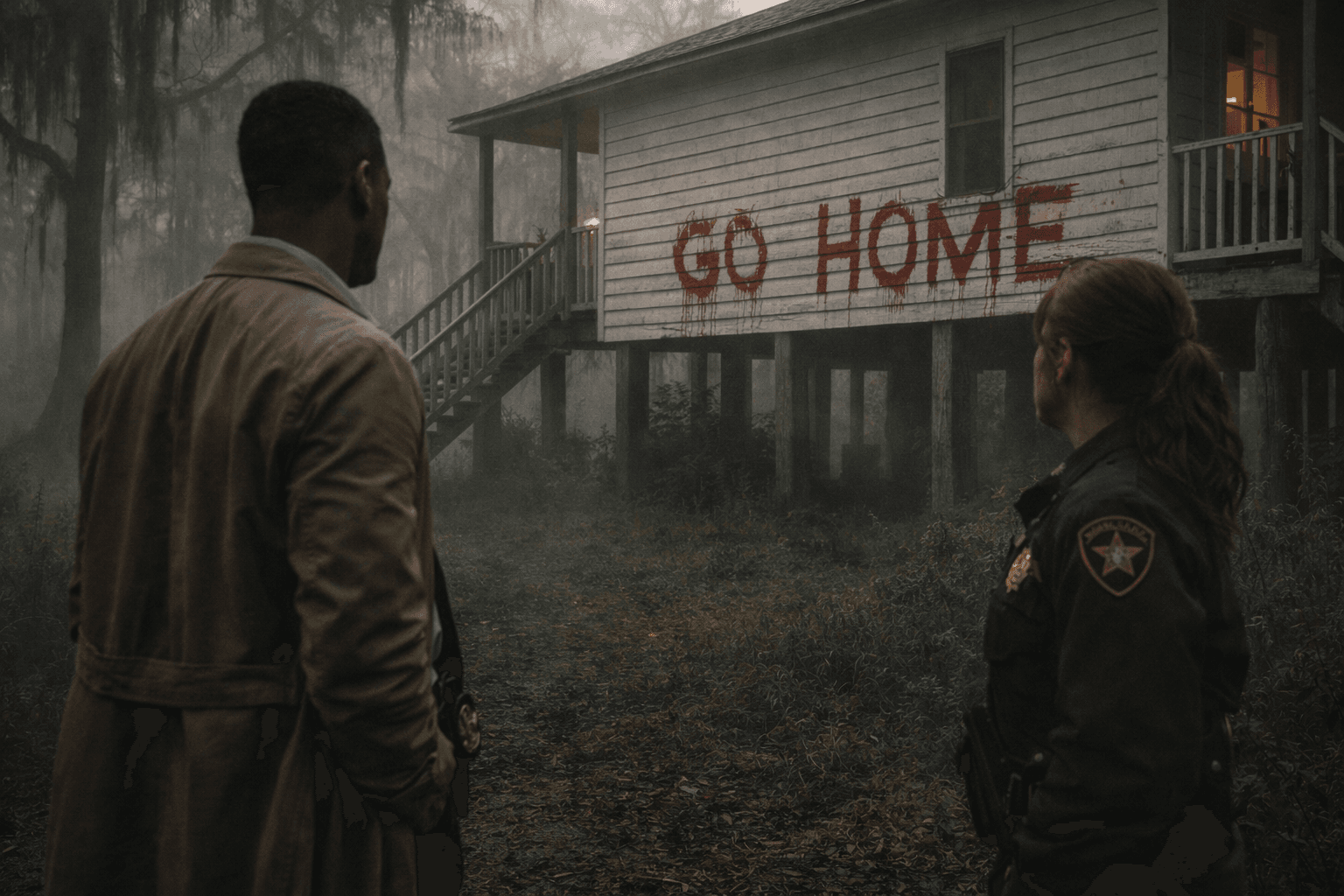
Julian opened it to find Sheriff Thibodeaux standing on the porch, hat in hand, her expression tight.
“We’ve got another one,” she said.
Before he could ask where the body was located, she stepped aside, and Julian saw it immediately—just beyond the edge of the yard, near the treeline where the swamp began to creep back toward the house.
The body belonged to a young woman—early twenties, maybe younger—her skin already dulled by the damp air. She lay curled on her side, knees drawn up, hands folded at her chest like someone had been taught how the dead were meant to rest. Her throat was torn open—ragged, brutal—darkened blood pooled beneath her jaw and soaked into the soil. Her ribcage had been cracked wide, the damage precise enough to be unmistakable. Something had been taken.
Where her eyes should have been, two smooth gray stones rested in place—cool, river-worn. Amethyst eyes had been painted onto their tops, wide and careful, the violet pigment stark against the gray.
“Same as the victim from yesterday,” he said quietly.
Sheriff Thibodeaux nodded. “Same as all of them.”
He looked at her then. “Every victim?”
“Every body we’ve found,” she confirmed, nodding grimly.”
“It’s time I see your boards,” he said. “Timelines. Evidence. Everything you’ve been tracking.”
Sheriff Thibodeaux nodded. “That was always the plan.”
The lack of any attempt to hide the body unsettled Julian. It had been placed where he couldn’t miss it—close enough to see from his porch, close enough to serve as a message.
Sheriff Thibodeaux glanced at him, then back at the body. “Looks like whoever did this wanted you to find it first.” She’d read his thoughts it seemed.
Julian stared at the treeline, at the place where the shadows still clung thick despite the rising light. For the first time since arriving in Saint Brigitte, something cold and certain settled in his chest.
Whatever had stood outside his window last night hadn’t been trying to scare him away.
It had been announcing itself.
“Before you say anything,” the sheriff added quietly, “there’s something else.”
She gestured toward the side of the house.
Julian followed her line of sight—and stopped.
Smeared across the white siding, uneven and dark, were two words written in blood. Not splashed. Not frantic. Carefully pressed there, each letter deliberate, the strokes thick and drying in the morning air.
GO HOME
Julian felt his pulse slow, sharpen.
The message wasn’t meant for the town.
It wasn’t meant for the dead.
It was meant for him.
____________________
The sheriff’s cruiser rolled slowly down the narrow parish road, tires whispering over damp pavement. Julian watched the landscape pass—low houses, leaning fences, stretches of swamp where the water crept close enough to kiss the road’s edge.
Ahead, the church rose out of the fog.
Our Lady of the Mire Catholic Church sat on slightly higher ground, its stone exterior darkened by age and moisture, as if the building itself had absorbed the swamp over time. The architecture was old Creole Gothic—arched windows narrow and tall, ironwork worked into looping patterns that resembled thorns more than vines. A bell tower leaned just enough to be unsettling, topped with a cross stained green at the base where oxidation had crept in.
The church had been expanded over decades, additions grafted onto the original structure without much concern for symmetry. It looked like something that had grown instead of been built.
Grave markers clustered behind it—some formal, some handmade, many tilted. The ground there never fully dried.
The evidence trailer sat beyond the church lot, parked between Our Lady of the Mire and the sheriff’s office, as if the case itself had been wedged deliberately between faith and law.
Julian shifted in his seat.
“That church been here long?” he asked.
“It sure has,” Sheriff Thibodeaux said. “Built after the Flood of 1837. Folks say it’s the only reason the parish survived.”
Julian watched the church slide past his window.
He wasn’t sure survival was the right word.
Just then, Julian’s pager vibrated against his hip.
He checked the number and frowned. Bad timing.
“Is there a phone in the trailer?” he asked.
Sheriff Thibodeaux glanced at him, then toward the boxy white unit parked between the church and the police station nearby. “Yeah. It works about half the time, though.”
“That’ll do.”
Once they’d parked, she unlocked the trailer and flipped on the lights. Julian stepped inside, the air immediately close and stale, smelling of paper and overheated wiring. He set his bag down but didn’t look at the boards yet. Not even a glance.
The phone sat on a narrow metal desk in the corner, cord coiled tight like it hadn’t been stretched much.
He picked it up and dialed.
The line clicked, hissed.
“Julian?” His friend’s voice came through thin and warped, like it was being pulled through water. “You there?”
“Barely,” Julian said. “You paged me.”
A pause. Static. Then, quieter—controlled, but barely. “I finally broke through your adoption records. Took some pulling.”
Julian leaned a hip against the desk, eyes on the far wall. “What’d you find?”
Another pause. Papers shuffling. The line crackled hard enough to swallow half a sentence.
“I found your birth mother.”
Julian closed his eyes for a beat. “Where?”
Static. Then—“Saint Brigitte Parish.”
Julian opened his eyes.
“That’s where you were born,” his friend continued. “What are the chances?”
Julian didn’t answer.
“She was born there too,” the voice went on. “Lived most of her life on a property just outside town. Died there.”
The lights in the trailer buzzed faintly overhead.
“What property?” Julian asked.
The line dipped, surged back. His friend’s voice dropped lower, steadier now, like he knew what the name would do.
“Belle Veil Plantation.”
The name settled in Julian’s chest with a weight he couldn’t quite place.
“Ever heard of it?” his friend asked.
Julian’s eyes drifted, unfocused, toward the boards lining the trailer walls—maps, photographs, red string blurred together at the edges. “No,” he said after a beat. “Can’t say that I have.”
Static hissed softly on the line.
“But… thanks for digging into this,” Julian added. “I know it wasn’t easy. I owe you a beer next time I’m back in New Orleans.”
A faint laugh came through the receiver. “You always do.”
“I’ll call you,” Julian said, and meant it.
He set the phone back in its cradle and stood there for a moment longer, listening to the hum of the trailer, the buzz of the lights overhead.
Then he turned back to the boards.
Photographs covered one wall—faces of the dead, missing persons flyers curling at the corners. Red string traced routes between dates and locations, lines intersecting and branching outward. Thirteen names were written in black marker. The sherrif had just added a fourteenth name, the ink still wet and glistening.
Julian stepped closer.
The pattern emerged slowly, inexorably.
Every line radiated outward from the same place.
The sheriff stood beside him. “We didn’t notice it at first,” she said. “Took a while before the pattern showed.”
Julian swallowed.
“Everything leads back there,” she continued. “Disappearances. Bodies. Sightings. Always within a few miles.”
His breath grew shallow as he followed them back, finger hovering just short of the center point where they converged.
Belle Veil Plantation.
The name stared back at him.
“No, it can’t be…” He whispered.
Without warning, another image pushed its way forward.
The side of his rental house. White siding streaked dark. The careful letters pressed into drying blood.
GO HOME.
At the time, he’d taken it for what it seemed—a warning meant to drive him out of Saint Brigitte Parish.
Now, standing here, the words shifted.
Go home.
Not away.
Back.
Back to the place he’d been born.
Back to the land his mother had never escaped.
Back to Belle Veil.
Julian’s jaw tightened.
IF that was true—if the message wasn’t meant to scare him but direct him—then whoever was doing this didn’t just know the land.
They knew him.
Sheriff Thibodeaux watched his expression change. “Agent Cross?”
Julian didn’t answer.
The case hadn’t brought him here.
It had called him home.