What The Dead Remember Origin Stories

The Widow At The Forest's Edge ~ Part One
Watch yourself, Mercy. Women alone invite darkness.
The warning came back to her at dusk, as it always did—unbidden, as though spoken directly into her ear. Mercy Hale stood at the narrow window, fingers curled around the warped wood of the frame, the shutter close at hand should she need to bar what lingered beyond. The leaded glass fractured the forest into wrong shapes—trunks bent where no wind stirred, branches caught mid-reach. The last pale light of day clung to the panes, thinned and strained, as though struggling to escape the trees altogether.
Cold crept through the seams of the window, carrying the damp smell of earth and pine. Mercy held her breath. The forest was silent—always silent and waiting.
The townspeople had called her and Tobias foolish from the first. Good Puritan folk did not build so close to ancient woods, not when the forest had been standing longer than scripture itself. Superstition clung to the place like damp wool, and the trees were spoken of as though they listened—as though darkness lingered there, patient and eager to mark anyone who wandered too near.
After Tobias died, their warnings followed her everywhere.
"Now Mercy, I don’t mean to be unkind," one woman had said, her sympathy already shaped like judgment. "But we warned you. We told you not to build so near the forest, and you would not listen."
Another voice had followed, lower and meant to carry. "Let this be a lesson. The Lord draws lines for a reason. Your husband has paid for that defiance."
They spoke his name like a caution. Tobias became proof rather than memory—evidence of what happened when faith wavered and boundaries were crossed. Mercy listened without protest, her face still, her grief folded carefully inward where it could not be taken from her.
Perhaps they were right.
For three long years, she and Tobias had prayed and labored for a child. Their wanting had grown quieter once it became clear no cradle would ever sit beside their hearth. Mercy bore that silence easily enough; she had learned how to carry things that could not be cured. But the town spoke of her barrenness in lowered voices, as though it were a stain that might spread.
Then Tobias fell ill.
Not slowly, not as men usually did, but all at once—as though something unseen had settled into his bones and claimed him. He was dead before the town could agree on the proper words to ask God why. At four-and-twenty, his life ended, and the whispers changed their shape.
What could not be born was forgotten. What had been taken demanded explanation.
It was then that something shifted beyond the glass, jarring Mercy from her troubled musings.
Her gaze caught on a shape just beyond the forest’s edge—a man, half-swallowed by shadow, standing so still he might have grown there. The last narrow band of daylight caught him in fragments: the pale line of a cheek, the rigid set of his shoulders. And then his eyes.
They caught the light wrong.
Not brightly—but keenly, as though the dusk itself had found something it recognized. The forest seemed to draw closer around him, branches leaning inward, shadows deepening, as if pleased to have been noticed at last.
Mercy did not wait to be certain.
She slammed the shutters and stepped back, the sound too loud in the sudden quiet. Her heart hammered against her ribs, fast and unrelenting.
She set about brewing a sleeping-tonic: chamomile, crushed mint, a shaving of valerian root - hands steady despite herself. These were remedies learned quietly, never spoken of aloud. Knowledge passed the way women's knowledge always had: hand to hand, person to person, kept from ledgers and pulpits alike.
From her mother. From her grandmother.
If the townspeople knew what Mercy could coax from leaves and roots, they would not call it wisdom. They would call it witchcraft.
And the word was already learning how to travel.
Later, beneath her quilt, Mercy lay rigid as the house settled around her. The night claimed the forest beyond the walls, patient and untroubled. For a moment, she thought she heard footsteps where no path lay—slow, deliberate, just beyond her door.
Then nothing.
Sleep took her at last, heavy and unkind.
And the forest waited.
_________________________________________________________
Dawn found Mercy at Tobias’s grave.
Seven months had passed since they laid him in the cold ground at the forest’s edge, where the land sloped gently away from the trees. The town had objected to his final resting place, but Mercy had not cared. Tobias rested where the light reached first in the morning, before the forest cast its long shadow.
She knelt and brushed frost from the stone with her bare hand. The cold bit deep.
“I dreamed of you last night, my love.” she said quietly. She did not expect an answer.
A movement at the edge of her vision made her still.
Someone stood just beyond the trees.
Mercy rose slowly and turned. The man had stepped out from the forest as if he’d always been there and she’d simply failed to notice him. The same man she’d seen the night before. He was tall—taller than Tobias had been—and built lean, his posture relaxed in a way that didn’t match his surroundings. His hair was light, almost silver-blond in the morning sun, falling loose around his face. He was handsome in a sharp, unsettling way: high cheekbones, a narrow mouth that looked like it knew too much, eyes pale and intent.
He watched her like she was the most interesting thing he’d ever seen.
“Haven’t you heard? God-fearing Puritan folk shouldn’t be out near the forest alone,” he said mildly.
Mercy didn’t answer right away. “I could say the same for you.”
A corner of his mouth lifted. “You could. But it wouldn’t stop me. I prefer being alone.”
She glanced toward the house, then back at him. “Did you come from the forest?”
“You already know the answer to that question.” His voice was deep, smooth and quietly commanding.
The honesty of it unsettled her more than any lie would have.
“Folks around here don’t venture into the forest,” she said. “It’s… forbidden.”
The stranger’s mouth curved faintly. “That’s what people say when they’ve decided not to look too closely at the unknown.”
He tipped his head toward the trees. “Most things called forbidden are only so because no one wants to be the first to step where they might be changed.”
Before she could form a response, a cow lowed from the pasture behind her, the sound strained and weak. Mercy’s shoulders tensed despite herself.
“That one’s ill,” he noted, nodding toward the sound. “The red cow. She’s been laying down since before dawn.”
Mercy’s breath caught. “Bess. Something has been wrong with her for days now.”
He looked at her then, really looked. “You named a cow?”
“So what if I did? ” Mercy said. “What do you want?”
He studied her for a moment, as though weighing something. Then he stepped closer. The air around him felt colder, though the sun had begun to warm the ground.
“There’s something wrong inside her,” he whispered. “Not sickness the way you’d expect. Something worse. It’s settled in her.”
“That doesn’t make sense.”
“It doesn’t need to.” He reached into his midnight blue cloak and drew out a small bundle wrapped in red thread. Inside was a pinch of dried yarrow and a pale stone shot through with thin silver lines.
Mercy stared. “And what, pray tell, is that?”
He met her gaze without flinching. “The cure to what ails her.”
She laughed once, sharp and disbelieving. “What am I to do with it? Do you expect me to trust you? You just came waltzing out of the forbidden forest and now you want me to give that to my cow?”
“If you want your animal to live,” he said easily. “Then yes.”
Her pulse thudded in her ears. “I don’t even know your name.”
He hesitated, then smiled, slow and deliberate. “It’s Caelith.”
“Caelith? What kind of name is that?” She asked, hesitantly reaching for the bundle. His fingers were cold when they brushed hers.
“A very old name.” Was his only response.
“How do I use this?” she asked, studying the stone with its odd markings. The silver lines almost resembled sigils, though such things were forbidden among the Puritans.
“Burn the plant to ash. Grind the stone. Mix both with warm milk and a pinch of salt. Give it to her before the sun reaches its height.” He paused. “She’ll hate it, but she must swallow it.”
Mercy weighed the bundle in her palm. “If it heals her, then she can hate me.”
When she looked up again, Caelith was already backing toward the trees.
“Why help me?” she called after him.
He stopped at the forest’s edge, where the ground darkened beneath the boughs. “Why not help you?” he said. “Would you not do the same for me, if I were in need?”
“I suppose I would,” she murmured, unsettled by the whole encounter—and intrigued, truth be told.
His gaze held hers, steady and intent. “You’ve not given up, even though your world has broken around you, Mercy Hale. That is a rarer strength than you know.”
Then he stepped backward, and the forest closed around him—branches drawing together, shadow settling—as though he had never stood apart from it at all.
Mercy remained where she was, her breath unsteady.
He knew my name.
She had not spoken it. Not to him.
The thought sent a chill through her, sharp and immediate. And yet—beneath the fear, unwelcome and undeniable—something else stirred. A pull she could not name. A sense of being seen too clearly, of being weighed and found wanting—and still chosen.
Mercy turned back toward Tobias’s grave, pressing her hand to her chest until her breath slowed.
Whoever Caelith was, he had not come to her by chance. Of this she was certain.
_________________________________________________________________
By midday, Bess stood chewing calmly in the pale winter sun, her flank rising and falling with steady breath. The tremor was gone. Her eyes were clear. Mercy rested a hand against the cow’s warm neck and let herself exhale. The elixir had cured the animal - within moments of consuming it.
When she straightened, her gaze drifted—unwillingly—back toward the forest.
It looked the same as it always had. Tall. Silent. Watchful.
Her thoughts were not.
She wondered where Caelith had gone once the trees closed around him. Whether he watched still. Whether he ever stopped watching. Where did he live? Where had he come from? The thought unsettled her—and yet, beneath it, something else stirred. She dared not explore that further…
The sound of hooves broke the quiet.
Mercy turned as a horse came up the narrow path from town, its rider hunched forward in the saddle. Reverend Pritchard reined in a short distance from the pasture fence, breath puffing as he dismounted with more effort than dignity. He was balding, his scalp pink and shiny where hair no longer bothered to grow, his body thick through the middle, his coat strained tight across his belly.
“Goodwife Hale,” he called, already smiling.
Mercy wiped her hands on her apron. She did not return the smile.
“Reverend.”
He took a moment to look her over before speaking again. She felt it like a hand dragged slowly along her skin. She was aware, suddenly and unpleasantly, of herself: the fall of her raven-black hair down her back, the pale skin at her throat, the amber of her eyes darkened at the edges with mahogany. Tobias had once told her she was beautiful in a way that surprised people. She had not thought of it as a burden until now.
“I heard your cow was ailing,” the reverend said. “Word travels.”
“It seems she’s recovered,” Mercy replied evenly.
“A blessing,” he said, though his eyes never left her face. “God is merciful, when He chooses to be.”
She stiffened.
“I came,” he continued, stepping closer, “to speak with you about your place among us. We’ve made allowances, Mercy. These past months. Grief requires patience.”
Seven months, she thought. He counted them like charity.
“But it is time,” he went on, lowering his voice, “for you to return fully to the congregation. To rejoin the life of the community. There are expectations.”
“Of widows,” Mercy said.
“Yes,” he agreed, too quickly. “Of women.”
His gaze dropped, slow and deliberate, before lifting again. “There are many men in our parish in need of a good wife. God-fearing men. Righteous men. They would not hold your… former difficulties against you.”
Her jaw tightened. “You mean my barrenness.”
He waved a hand, as though brushing away a minor inconvenience. “The Lord may yet smile upon a new union. It is not uncommon for a woman to flourish under proper spiritual guidance.”
Mercy felt something hot and sharp coil in her chest.
“Perhaps,” the reverend continued, “your late husband was… misaligned. Wayward in his faith. God does not bless disobedience, Mercy. You must have considered that.”
The words landed like a slap.
Tobias’s name, handled like a moral failing. Like a reason for her misfortune.
Reverend Pritchard smiled then, small and knowing. “You are still young. Still pleasing to the eye. It would be a shame for such gifts to go unused.”
Mercy’s hands curled at her sides.
“I will return to the meetinghouse when I see fit,” she said, her voice steady through sheer will. “And I will not be discussed as though I were livestock to be traded.”
His smile thinned.
“Careful,” he said softly. “Independence invites scrutiny. And scrutiny invites correction.”
He mounted his horse with a grunt, gathering the reins. “Think on what I’ve said. The town has been patient. Patience does not last forever.”
He turned the horse and rode away without another word.
Mercy stood where he had left her, the cold creeping up through the soles of her boots. Her skin felt tight, as though she could not quite settle back into herself.
Anger rose—slow, deep, and dangerous.
She turned her face toward the forest once more.
For the first time, it did not feel like a threat.
It felt like a boundary.
And Mercy knew, with a clarity that startled her, that if the world insisted on pressing in—she would not hesitate to cross that boundary if it offered her peace.
_________________________________________________________________
Days slipped into a week, and night came on once more, finding Mercy pacing the length of the cottage as the floorboards creaked beneath her steps.
Seven months, and still her thoughts returned to Tobias when the house grew quiet. He had been a stocky man, solid through the shoulders, brown hair always in need of cutting, green eyes that warmed when they found hers. His beard had been coarse against her cheek; his laughter easy. He was not a man women turned to look at twice—but he had been hers. Her companion in all things. Her friend. Her lover.
The loneliness sat heavy now, sharper in the evenings.
She stopped near the door, her gaze catching on the stacked firewood just inside the threshold. Cut clean. Split evenly. Enough to have carried her through the worst of winter and still see her well into summer. It had appeared, a few pieces at a time, quietly, over weeks. Mercy had told herself it was kindness. A neighbor unwilling to be named.
Lately, she doubted that.
Old Mistress Alden’s words returned to her, whispered just two days ago as they passed one another on the road.
“Have you heard? The cattle are dying all over. Sheep turning up stiff in the fields, and the hens have stopped laying. Folks are saying it’s a judgment—on someone, though no one will name them. We’re all paying for their sin.”
Mercy’s own animals remained strong. Untouched since she’d used Caelith’s elixir. Bess’s milk ran rich. The hens laid steady. There was no sickness. No wasting.
What would the town say if they knew she did not suffer the same judgment as the rest?
A sharp sound broke her thoughts.
Not a knock—something lower. A low growl. Then another.
Mercy moved to the window and parted the shutter just enough to look out.
Her breath caught.
Wolves.
Not one or two—but a full pack, dark shapes moving with purpose across the clearing. Their eyes fixed on the barn. On Bess, penned inside, lowing in alarm.
Mercy’s heart hammered. She did not think. She turned and seized Tobias’s gun from where it rested above the hearth—a matchlock musket, heavy and awkward in her hands. Tobias had taught her to fire it once, years ago. In case, he’d said.
She yanked the door open and ran.
“Go on!” she shouted, raising the musket.
The wolves turned as one.
She pulled the trigger.
The powder flashed—but the shot failed, the mechanism coughing uselessly. The sound only enraged them.
They came at her fast.
Mercy backed away, stumbling, her heel catching on hard ground. One lunged and its teeth sank into her ankle, white-hot pain ripping through her as she screamed and fell. The pack closed in, snarling, circling.
Then something cut through the chaos.
A sharp whistle. The snap of a bowstring.
One wolf dropped. Then another. And another—each arrow clean and precise, striking before she could follow the movement.
The remaining wolves scattered into the trees, leaving the ground darkened and still.
Caelith stood where the last wolf had fallen, a longbow in his hand.
Pain roared through Mercy’s ankle, brutal and unrelenting.
He dropped to one knee in the churned earth beside her. “It’s okay, Mercy” he said, his voice low and comforting. “Don’t try to move your foot.”
She sucked in a breath, teeth clenched. “I—I thought the gun would fire. Tobias showed me. I swear he did. I thought I knew what I was doing.”
“I know.” His hands were steady as he removed his cloak and pressed it against her bloody ankle. “The mechanism’s old. Damp powder. It happens.”
“They were going for Bess.” Her voice broke despite her effort. “She’s all I have left. I couldn’t lose her.”
His eyes lifted to hers. “You were very brave, Mercy.”
“What was I meant to do?” she continued to lament, daring him to scold her. “Stand and watch?”
He didn’t take the bait. “No,” he said at once. “You did what anyone with sense and heart would do.”
The pain surged again, sudden and blinding, and Mercy cried out despite herself. Her hands clutched at his sleeve, fingers slick with blood.
“Sorry, but it hurts so bad,” she said through clenched teeth. “I don’t think I can stand it much longer.”
“I know,” Caelith said, his voice low and deep, steady enough to anchor her even as the world tilted. He slipped an arm beneath her knees and another around her back, lifting her with careful strength. The movement jarred her ankle and she hissed, clutching tighter.
“Relax, Mercy,” he murmured as he carried her toward the cottage, his voice close now, resonant against her ear. “I’ve got you.”
The sound of it—calm, unhurried—soothed something frantic inside her. She barely registered the door opening, the rush of warmer air, the shift as he laid her down on her bed inside the one room cottage.
He knelt at once, turning his attention back to her ankle, his brow furrowing as he examined the wound. “Look at me,” he said gently. “Mercy—look here. Don’t look at your ankle.”
She forced her gaze to his face. He was very close. Too close. Golden hair had fallen loose around his temples, catching the dim lantern light, his sharp features softened now by concentration. His bright blue eyes held hers—focused, intent, and threaded with something else she could not name.
“You’re going to be all right,” he said. “Stay with me.”
“I can’t feel my foot,” she whispered. Panic edged her voice. “Is it—”
“No,” he said quickly. “It’s deep, but your bone is in tact. You’ll keep your foot. The blood makes it seem worse than it is.”
“I don’t know if I believe you,” she said faintly.
His mouth curved—not a smile, exactly, but something warmer. “Pain always exaggerates. You will be fine.”
Her breath came shallow now, the cold creeping in around the edges of her vision.
“Don’t let me die,” she said, the words tumbling out before pride and reason could stop them. “Not like this. Not from a wolf bite.”
Caelith’s jaw tightened. “Come now, Mercy. You’re being dramatic. You’re not dying.”
His hand settled more firmly at her ankle.
Then Mercy felt it.
Warmth.
Not the fevered heat of pain, but something steady and deep, spreading outward from where his fingers held her. It sank into the ache, softened it, quieted it. The sharpness dulled. The fire eased. The warmth traveled slowly up her leg, easing muscle and bone alike.
Her breathing slowed without her meaning it to.
“That’s—” she murmured. “That feels… different. Better. What did you do?”
Caelith did not answer right away.
Her eyelids grew heavy. The world narrowed to the sound of his voice, low and close.
“Rest,” he said. “You’ve endured enough for one night.”
“I don’t—” Her words slurred. “I don’t know why you keep coming back to check on me.”
His voice lowered. “Do I need a reason, Mercy Hale? Perhaps I find you intriguing. Perhaps your loneliness calls to something within me. Perhaps you’ll never know.” A smile spread across his handsome face as he gazed down at her.
The warmth in her ankle spread higher now, chasing the pain away until it felt distant, unreal. Mercy’s grip on his sleeve loosened.
“Don’t go,” she whispered, already half-unconscious.
“I’m here,” he said. “I won’t leave you alone tonight.”
The last thing she felt before darkness claimed her was his hand steady at her ankle—warm, certain—and the strange, undeniable sense that something within her had been answered.
Then Mercy slipped into unconsciousness, the pain gone, the night closing gently around her.
__________________________________________________________________
Morning came softly.
Light crept through the narrow window in thin bands, catching on dust and the rough-hewn beams above her bed. Mercy woke slowly, the way one does after deep exhaustion, her body heavy but strangely at ease.
For a moment, she forgot why.
Then she moved her leg—and felt no pain.
Her breath caught as she pushed the quilt aside.
Her ankle was bare, unwrapped. The skin was whole. Unbroken. Only the faintest pale marks remained, thin crescents where teeth had torn flesh the night before. No swelling. No heat. No stiffness. It should have been impossible.
It wasn’t.
Mercy’s heart began to race.
She shifted upright, dizzy, and that was when she saw it: a small cup resting on the bedside table, carved wood darkened with age. Inside it, a clear liquid caught the light, faintly clouded with what looked like crushed leaf or root.
Beside it lay a narrow scrap of cloth, folded once.
She picked it up with unsteady fingers. A few words had been written there in dark ink, pressed firmly into the weave.
Drink this as soon as you wake.
No name. No mark.
Mercy’s breath left her in a slow rush. She closed her fingers around the cloth, her chest tightening—he had left this for her. He had seen her safely through the night.
She looked toward the door. The hearth was cold. The cottage empty. Whatever warmth had filled the room the night before was gone, leaving only its echo behind.
Mercy lifted the cup and smelled it—water, herbs, something sharp and clean beneath. She hesitated only a second before drinking. The liquid was cool, grounding, leaving a gentle heat in her chest that spread outward as she swallowed.
She closed her eyes.
Images rose unbidden: pale hair falling loose, ice-blue eyes intent on her face, a deep voice steadying her as the world slipped away. Strong arms carrying her across the threshold. Hands at her ankle, sure and warm.
Her face warmed at the memory.
Magic.
There was no other word for it.
The realization should have frightened her. Instead, it sent a quiet thrill through her—low and unsettling and entirely unwelcome. A sense of having brushed against something forbidden and finding herself unwilling to pull away.
A man like Caelith would be named a devil in the meetinghouse. Or worse—a witch.
Mercy pressed her fingers to the faint scars at her ankle, her pulse quick beneath her touch.
The thought made her breath quicken, her mouth curve despite herself.
She rose carefully from the bed and crossed to the window, looking toward the forest as sunlight filtered through the branches.
Somewhere beyond the trees, she knew he was watching—or had been.
And for the first time since Tobias died, Mercy did not feel afraid of what waited there.
She felt awake.
__________________________________________________________________
Caelith began to come every day.
Sometimes at dawn, when mist still clung low to the ground. Sometimes at dusk, when the light thinned and the forest grew restless. Mercy would look up from her work and find him already there—leaning against the fence, standing at the edge of the yard, watching her as if he’d been there for some time.
He brought rabbits, their necks broken clean. Once, a brace of grouse wrapped in cloth. Another time, strips of venison smoked dark and fragrant, rubbed with salt and crushed leaf. He set small jars on her table—oils steeped with roots, salves thick and sharp-smelling, powders to be stirred into mash or warm milk.
“For the hens,” he said once, setting a wrapped bundle on the table. “And this for Bess and the goats. Sparingly.”
Mercy eyed it. “And how am I to know this won’t kill them?”
His mouth curved, unapologetic. “You don’t.”
She huffed a quiet laugh despite herself. “That’s not reassuring.”
“They’re still standing,” he said mildly. “So are you.”
Her animals flourished. Their coats shone, eyes stayed bright, milk ran rich and steady. In town, the looks changed. Conversations stopped when she passed. Whispers followed her down the road—envy sharpened into suspicion.
Why are her beasts thriving, they wondered, when ours fail by the day?
And Mercy knew, with a tightening in her chest, that it would not be long before someone asked the question aloud.
It made her realize how little she truly knew about the man who had become part of her days.
She asked him, more than once, where he lived.
“Close enough,” he’d always reply.
“That tells me nothing.”
“It tells you I can hear you when you call.”
She didn’t like the way that made her pulse jump.
The wanting crept up on her quietly. She caught herself waiting by the window at dusk. Listening for his step. When he stood too near, her breath shortened. When his hand brushed hers—passing a jar, steadying her wrist—she felt it long after he let go.
One afternoon, he lingered.
The air between them felt charged, as though the space itself had leaned inward. He handed her a small vial of clear liquid meant to ease her into sleep, his fingers warm as they closed briefly around hers, the glass cool and unfamiliar against her palm.
“For the nights,” he said. “When they grow too long and you can’t sleep.”
Mercy nodded, unsettled by how easily she trusted him.
Later, they ate together outside the cottage, the sun mild on their faces, the earth softening at last beneath winter’s retreat. Mercy brought out coarse brown bread and a wedge of sharp cheese, its rind cracked from age. Caelith added thin slices of dried venison he’d brought with him, dark with smoke and salt, and an apple he split neatly with her knife. They shared a cup of tart cider, passing it back and forth without ceremony.
They sat on the low stone by the door, close enough that their shoulders nearly brushed. A breeze moved through the budding hedgerow. Somewhere, birds tested new songs.
For a time, neither of them spoke.
Mercy realized—quietly, and with a faint ache—that she had not eaten like this since Tobias died. Not with ease. Not without counting the hours until the silence returned.
She glanced at him to find him watching her intently.
“You’re staring,” she said.
“So are you.”
She swallowed. “You make it difficult to look away…”
His mouth curved. “I’ve been told.”
They were close—too close. His gaze dropped to her mouth. Hers followed, helpless. The moment pulled taut, trembling--
Hooves thundered into the clearing.
Mercy startled, her breath catching, as Reverend Pritchard rode up without slowing, his horse tossing its head as if it sensed the tension before she did. He reined in hard, leather creaking, his face already set in a familiar mask of disapproval.
His eyes snapped first to Caelith.
Then to Mercy.
She rose at once, brushing crumbs from her skirt with hands that had gone suddenly unsteady. Caelith stood as well, but he did not step away from her. If anything, he angled himself slightly closer, a quiet, deliberate choice.
“And who,” the reverend said at last, his voice sharp with authority he expected to be obeyed, “might this be?”
Caelith regarded him calmly. “A guest.”
Pritchard’s mouth tightened. “This is not a place for guests. Not for men unknown to this parish.”
Caelith’s gaze did not flicker. “Then it’s fortunate I didn’t come to see the parish.”
The reverend’s eyes narrowed. “You’ll mind your tone.”
Caelith smiled faintly, not apologetic in the least. “I am.”
Pritchard turned his attention back to Mercy, his expression softening in a way that made her skin prickle. “Goodwife Hale,” he said, as though the name itself were a correction. “You should remember yourself.”
Before she could answer, Caelith spoke again—quiet, steady.
“She remembers herself well enough,” he said. “You seem to be the one confused about your welcome.”
The air was taut with tension.
For a long moment, the reverend said nothing, his jaw working as he weighed the insult against the impropriety of causing a scene. His gaze flicked once more over Mercy, lingering in a way that made her stomach turn.
“This is not finished,” he said finally, the words pressed thin. “I will be speaking of this to the congregation.”
“I’m sure you will,” Caelith replied.
Pritchard jerked the reins, wheeled his horse, and rode off, the sound of hooves sharp and angry as they vanished down the path.
Silence fell back into the clearing, heavier than before.
Then Mercy laughed—short, breathless. “You shouldn’t have done that.”
Caelith grinned. “Yes, I should have and I enjoyed it thoroughly.”
“You’re trouble.”
“Yes, I am.”
She shook her head, still smiling. “You’ll get me hanged.”
“Not today. Not ever on my watch, Mercy Hale.”
He reached for her then, slow enough to stop if she asked him to. His fingers brushed her jaw, tilting her face up. His eyes searched hers.
“Tell me to go,” he said.
She didn’t.
He kissed her.
It wasn’t gentle. It wasn’t careful. It was hungry and sure, his mouth warm and firm, stealing the breath from her lungs. Mercy clutched his cloak, her knees weakening as the world narrowed to his mouth and the press of his body close enough to feel.
When he pulled back, her lips tingled. Her heart pounded painfully in her chest.
“Show me,” she whispered. “Where you live. Please.”
His expression shifted—something serious, measuring.
After a moment, he nodded. “I think you’re finally ready.”
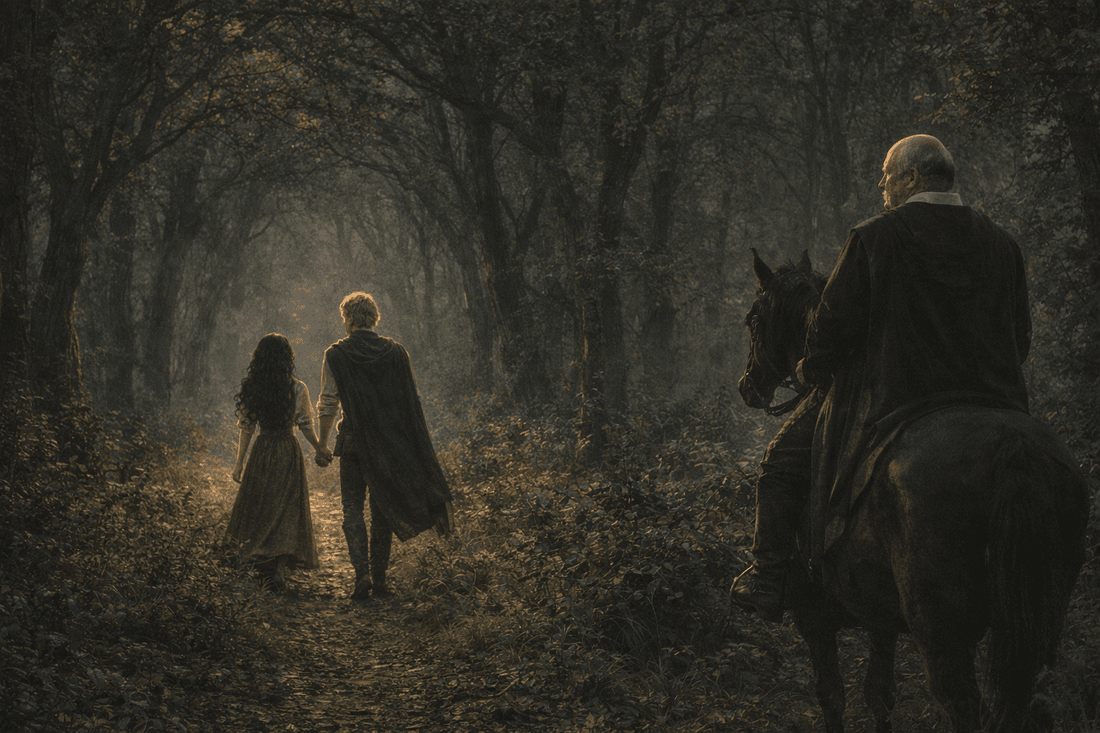
He took her hand.
Together, they walked toward the forest.
Mercy did not look back.
The trees opened, the light dimmed—and she stepped forward, into the dark, not knowing if she would ever return the same.