The Widow At The Forest's Edge ~ Part 3
Mercy could not leave him there.
The thought took root with the same awful certainty as the cold creeping through his body beneath her touch. Caelith still hung above her, limp and wrong against the branches, iron biting into his pale flesh like a final cruelty. The forest held its breath. Even the birds had gone quiet.
She pressed her forehead to his hanging hand and closed her eyes, just for a moment, as though the world might soften if she did.
It did not.
The Native woman moved behind her, gentle as a shadow. She did not speak, only laid a steady hand against Mercy’s shoulder.
Mercy drew a shaking breath. “We can’t leave him,” she whispered. The words felt too small for the weight of what had been done. “Not like this.”
Together, they took in the chains that bound him to the branch above.
They were iron.
Mercy did not reach for them. She knew better than to try.
The Native woman moved past her, silent and sure. She returned from the ruined camp with a heavy woodman’s axe—taken from one of the hunters who would never use it again. Its blade was nicked and darkened with old sap and blood.
She placed it in Mercy’s hands.
Mercy swallowed. Her arms felt too weak to lift it. Her heart felt too broken to try.
But there was no other way.
She raised the axe and struck the thick branch above Caelith’s head. The impact shuddered through her bones. Wood split. Leaves rained down around them. She struck again, and again, each blow a dull thunder in the hollowed clearing.
Tears blurred her vision. Her arms burned. But she did not stop.
With a final, desperate swing, the branch cracked.
A long groan of breaking wood filled the air—and then it gave way.
Caelith fell.
Mercy tried to catch him.
The impact drove her back to the ground, knocking the breath from her lungs. She held him there, his head slipping against her shoulder, his hair brushing her cheek as if he might stir.
He did not.
His body was cold against hers. Too heavy. Too still.
Mercy touched his face with trembling fingers. “I’m here,” she whispered, as though he might somehow hear it now. “I’m still here.”
But there was no answering pull. No warmth in her chest. Only the ache.
A sound broke from her, raw and broken. “This is what they call righteous,” she murmured. “This is what their Puritan values leave behind.”
The Native woman knelt beside her, eyes dark and shining.
Mercy bowed her head against Caelith’s shoulder. “Those monsters only know how to take,” she whispered. “If there is anything left in this world that can make this right… it won’t come from them.”
She lifted her gaze then, something hard and bright cutting through her grief. “I have to reach the tree,” she said. “The gate. His people need to know.”
The woman nodded.
Together, they drew Caelith into the shelter of the roots, laying him among shadow and leaf as gently as they could. Mercy pressed her palm to his chest one last time.
“You deserved more than this,” she murmured. “I’ll make sure they know what was done to you.”
____________________
The forest closed around Mercy as she left the clearing behind.
Branches brushed her sleeves. Damp earth gave beneath her boots. The forest felt different now—not hostile, not kind, only vast and watchful. It had given her wonder once. Now it held her sorrow.
She tried to think clearly, but her thoughts would not settle. All she could see was his face, pale and still, the iron biting into him even in death. He had belonged to another world. To another people. And she had let him die alone among strangers.
“I won’t leave you that way,” she murmured, though there was no one to hear her. “I won’t.”
The tree. The gate.
If there was any place left that might hold an answer, it was there.
She pushed deeper into the forest, toward the place where the world had once opened for her, and prayed to the God she had always known—the One who remained faithful, even when His people had not.
The tree stood exactly where she had left it.
Its roots curved through the earth like something alive, ancient and waiting. Mercy stumbled toward it, breath burning in her chest, her skirts snagging on bramble and stone. The world felt thin here, as though one wrong step might tear it open.
“Please,” she whispered, pressing both palms to the bark. “Please—Caelith. I don’t know how to do this without you.”
The door shimmered into being beneath her hands, faint as breath on glass. Not fully there. Not yet gone. As though the world itself were deciding whether to let her pass.
Mercy sobbed. “I’m here. I’m trying. Don’t shut me out.”
She leaned forward--
“Enough.”
The word cracked through the forest like a shot.
Mercy turned.
They stood at the edge of the clearing, dark shapes against the pale morning: Magistrate Crowe at their center, Reverend Pritchard beside him, a half-circle of hunters fanned out behind them. Rope hung from their hands. Iron glinted at their belts.
Crowe’s eyes found the door at the base of the tree. His mouth tightened.
“So it does exist,” he said softly. “The devil’s own threshold.”
Mercy moved to shield it without thinking. “You don’t understand—”
“Oh, we understand quite well,” Pritchard said. His voice carried that terrible calm he used when he meant to be merciless. “We warned you what comes of consorting with the wild. With things not made by God.”
“Who’s to say this isn’t also God’s creation? Caelith was one of God’s children, too. It wasn’t sin,” Mercy said. “It was—”
“Silence,” Crowe snapped. “You’ve done enough speaking.”
The hunters advanced.
Mercy backed toward the tree, heart pounding. “Don’t touch it. Don’t you dare—”
Hands seized her arms.
She fought them, nails clawing, skirts tearing as they dragged her backward. “Let me go!” she cried. “Please—just let me go!”
Crowe watched her struggle with something like satisfaction. “You’ve led us straight to it, Mistress Hale. The source of all this rot.”
As they pulled her away, Mercy caught sight of movement in the trees.
The Native woman stood there, half-hidden by leaves and shadow. Her dark eyes met Mercy’s—steady, unafraid. She did not move. Did not speak.
Mercy was dragged farther from the tree, from the door that flickered now like a dying flame.
“I’m sorry,” Mercy whispered, not knowing whether she meant Caelith or the woman in the woods. “I’m so sorry.”
The door faded.
The bark closed.
And the forest swallowed the last chance she had to save him.
____________________
Mercy stumbled as they dragged her back toward New Canaan, the trees thinning, the air changing. Crowe walked ahead of her, straight-backed and silent, while Reverend Pritchard lingered close enough that she could feel his breath when she faltered.
“Look at her,” one of the hunters muttered. “Like something dragged up from the wild.”
Another snorted. “That’s because she’s been lying with it. A fae’s whore, running through the woods like some heathen.”
Mercy jerked against their grip, fury flaring through the pain. “He was a kind soul that you murdered,” she said hoarsely. “A soul who showed me more kindness than all the so-called Christians in this town ever did. And I am no one’s whore.”
The hunter laughed. “You expect us to believe that thing treated you with virtue?”
“He treated me with humanity,” Mercy snapped. “Which is more than you did when you strung him up like an animal.”
“Enough,” Pritchard said sharply.
“I have done nothing wrong,” Mercy went on, her voice shaking but unbroken. “I loved him. That is not a sin. Your cruelty is.”
The blow came without warning.
Pritchard’s hand struck her face so hard her head snapped sideways. The taste of blood flooded her mouth, hot and metallic.
“Careful,” he said softly. “You’re not in the forest now. There’s no one left to coddle you in your sin.”
Mercy swallowed, her jaw burning, but she did not look away. She met Pritchard’s gaze with open defiance, daring him to strike her again.
With a dismissive grunt, he turned and continued on.
They marched her through the village as though she were already condemned. Doors opened. Faces appeared. No one spoke, but their eyes did. Sinner. Whore. She could hear their thoughts as plain as day.
Crowe turned toward her as they passed the meetinghouse. “You led us straight to their hiding place, Mercy Hale. To the source of this corruption. That was God’s hand. He sees all.”
“That was not God,” Mercy said hoarsely. “He indeed sees all and He has seen what you’ve done—murdering the innocent and dressing it up as righteousness so you can keep your grip on everyone else.”
His mouth twitched. “You are walking very close to the flames, Mercy.”
They did not take her directly beneath the meetinghouse. First, they brought her through the magistrate’s quarters, through a narrow passage, and into a low room lit by a single window barred with iron. A woman waited inside.
Martha Pritchard.
She stood taller than Mercy, sharp-faced and thin-lipped, her hair drawn so tight it only sharpened the severity of her plain features. Her eyes raked over Mercy from head to toe.
“So this is her,” Martha said. “The whore of the woods.”
“I am not—”
Martha slapped her.
“You’ll speak when spoken to, Jezebel.”
Crowe handed Martha a ring of keys. “You are to watch her until she can be properly judged.”
Martha smiled without warmth. “With pleasure.”
They took Mercy then—down stone steps, through the narrow door beside the pulpit, into the guardroom beneath the meetinghouse.
It smelled of damp and old fear.
Crowe turned to her. “Confess.”
“I have nothing to confess.”
Pritchard stepped forward. “You consorted with something unholy.”
“I loved him.”
That earned her another blow.
“You loved a demon,” Pritchard said. “And you will repent for it.”
Mercy tasted blood. “I will not repent. My God isn’t afraid of love.”
Crowe’s fist struck her this time.
They did not stop at one.
When at last they were finished, Mercy lay on the stone floor, shaking, her ribs aching, her vision swimming. Crowe crouched beside her.
“You think yourself chosen,” he said quietly. “You think the fae demon’s favor makes you special.”
He leaned closer. “It makes you dangerous. And for this, you will burn at the stake.”
They left her there.
Martha Pritchard descended the steps not long after, lantern in hand. She looked down at Mercy with something like satisfaction.
“You will stay here,” she said. “Until we decide what kind of fire suits you.”
Mercy did not answer at once. Her body ached. Her throat burned. But she forced herself upright against the stone wall, meeting Martha’s gaze.
“You’ve fallen far,” Martha said, circling her slowly. “Out of obedience. Out of God’s grace. Into wickedness. That thing you followed in the forest—whatever it was—it has led you straight toward hell.”
Mercy let out a breath that was almost a laugh. “The God you speak of,” she said softly, “is not the one I know.”
Martha’s eyes narrowed. “Blasphemy.”
“No,” Mercy replied. “It is humility. You speak as though you know the full measure of His creation—as though anything not named in Scripture must therefore be wicked.” Her voice trembled, but it did not break. “But God made the heavens and the earth, and all that moves within them. Who are we to say we understand all He has fashioned?”
“I know nothing of those things, Mercy Hale. But what I do know is that you consorted with a demon,” Martha snapped.
“I loved someone who was not like us,” Mercy said. “That does not make him unholy. And it does not make God small. The forest exists. Other worlds exist. Other wonders exist. Their being does not diminish Him.”
Martha stared at her as though she were something unclean.
“I am not afraid of your hellfire,” Mercy went on quietly. “My faith was never in your judgments. It was always in God.”
Silence stretched between them.
Then Martha smiled.
“Well, well, Mistress Hale,” she said coldly. “Your blasphemous words will make watching you burn all the sweeter.”
She turned and climbed the steps, leaving Mercy alone in the dark beneath the meetinghouse—bruised, bound, and still unbroken.
____________________
Morning came gray and cold, though it was the heart of summer.
A wind moved through New Canaan that did not belong to the season, lifting Mercy’s loose hair and chilling her skin as they dragged her up from beneath the meetinghouse. The sky hung low and colorless, as though even heaven refused to look upon what was about to be done.
Crowe walked ahead. Pritchard beside him.
The village was already gathering.
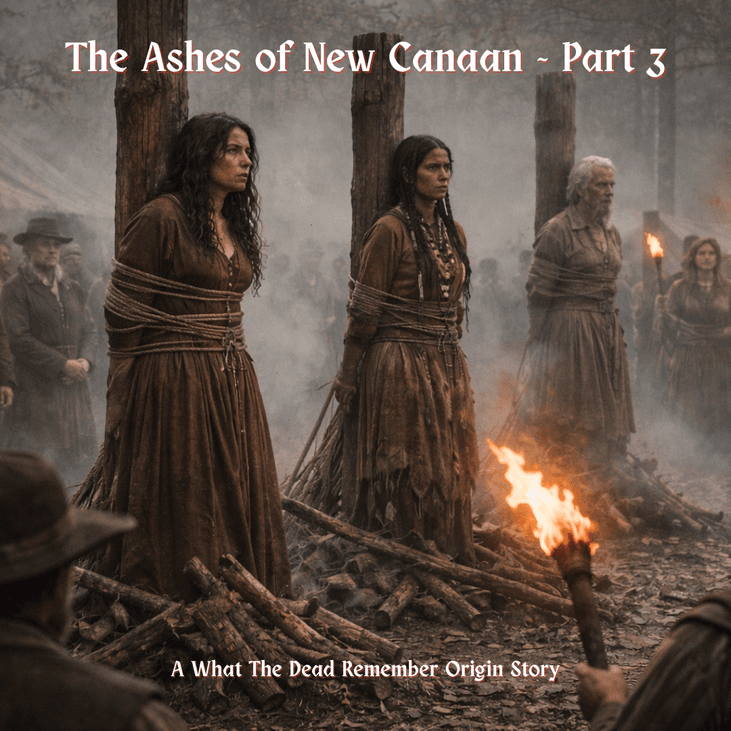
They brought her to the clearing beyond the common, where five wooden stakes had been driven into the earth. Fresh-cut. Still smelling of sap.
Mercy’s heart stuttered.
“So many,” she murmured.
Martha Pritchard gripped her arm. “Witchcraft spreads like rot,” she said. “Better to burn it out.”
Crowe addressed the murmuring crowd. “Across the colonies, God’s judgment is being carried out. From Connecticut to Salem, from Plymouth to the frontier—witches are being rooted out so this New World may be kept pure.”
A few men nodded. Some crossed themselves. Others watched Mercy with something like hunger.
They tied her wrists to the stake, rough rope biting into her skin.
Movement stirred at the edge of the crowd.
Two hunters dragged a woman from the trees. Her ebony braids hanging in her face, her clothes torn, her face streaked with dirt and blood—but Mercy knew her instantly.
The Native woman.
“No,” Mercy breathed. “No—leave her.”
The woman struggled fiercely, crying out in a language Mercy did not know. They forced her to the second stake and bound her there, rope wrapped cruelly tight.
Three more figures were brought forward.
A trembling old woman Mercy recognized from the edge of town, one who sold herbs.
A thin girl, no more than sixteen, eyes wild with terror.
A man with a limp who had once begged for food at Mercy’s door.
All accused. All condemned.
The Native woman lifted her head and met Mercy’s gaze.
"My name is Wàhkina," she said softly, the words careful, measured. "It means...wind."
Mercy startled despite herself, her breath catching. "You speak my language?"
Wàhkina watched her closely for a long moment before nodding once. "Enough," she said. "But it is not safe for the white men to know that I do."
Mercy felt the weight of that settle between them. "Then why tell me?"
"Because I trust you," Wàhkina replied simply.
Mercy swallowed hard. "I'm Mercy."
A faint curve touched Wàhkina's mouth, there and gone like a breeze through leaves. "I know."
She hesitated, then leaned as far toward Mercy as the ropes would allow. Her voice dropped low, meant only for her.
“When they took you,” she whispered, “the tree did not close. It listened.”
Mercy’s breath caught. “What do you mean?”
Wáhkina’s eyes flicked toward the forest. “I was not alone.”
Before Mercy could ask more, a hunter shoved Wáhkina back against the stake.
The sky darkened.
And somewhere beyond the treeline, unseen and unheard, the forest began to stir.
Pritchard stepped forward as the ropes were tightened and the crowd fell into a hush. He raised his Bible.
“The Lord is a jealous God,” he proclaimed, his voice ringing across the clearing. “And He suffers no unclean thing to dwell among His people. Scripture tells us that those who consort with darkness must be cut away, lest the rot spread through the body of the faithful.”
A murmur of approval rippled through the gathered townsfolk.
“Witchcraft is rebellion,” he went on. “And rebellion is as the sin of sorcery. We do not do this in cruelty—but in obedience.”
Mercy fought against her bonds. “You’re lying,” she cried. “You’re using His name to hide your own sins!”
Crowe gave a sharp nod.
The first torch was lit.
The beggar tied to the farthest stake began to sob, his voice breaking as flame was brought to the dry wood at his feet. Smoke curled upward, thick and black, and his cries rose with it — filling the air, filling Mercy’s chest, filling the sky.
The crowd recoiled and leaned in all at once.
The next torch was taken to the trembling girl.
“No,” Mercy whispered. “Please—”
The fire caught.
The old woman cried out, a sound so full of terror it seemed to split the morning itself. She looked over to see the withered flesh melting from the woman’s bones.
Mercy’s world narrowed to heat and horror and the terrible certainty that no one was coming.
Then--
The forest answered.
A wind tore through the clearing, sudden and violent, ripping at cloaks and scattering ash. Shadows surged between the trees, moving far too fast, far too many.
Fae burst from the forest.
Men and women alike, tall and radiant and terrible, their eyes glowing with fury older than the colony itself. Steel flashed. Light flared. The air filled with cries—not of the condemned, but of the condemners.
The hunters fell first.
Crowe shouted orders that no one could follow.
Pritchard raised his Bible as though it were a shield.
It did nothing.
Through the chaos, a figure moved straight toward Mercy.
He was tall and dark-haired, silver threading through his temples, and Mercy knew at once he was Caelith’s father—his presence bending the air around him like a storm held in human shape.
He cut her bonds with a single motion.
“Eryndor,” he said, gripping her shoulders. “We met once before, Mercy.”
The Native woman cried out as flame licked her legs. Eryndor turned and freed Wáhkina, pulling her from the burning stake even as smoke swirled around them.
“Run,” he commanded. “Hide. Do not come out until the sun rises.”
Mercy stumbled, pain blazing through her limbs, as the forest swallowed her once more.
Behind her, New Canaan burned.
And the screams of its people rose to meet the wrath they had called down.
____________________
Dawn rose over New Canaan without ceremony.
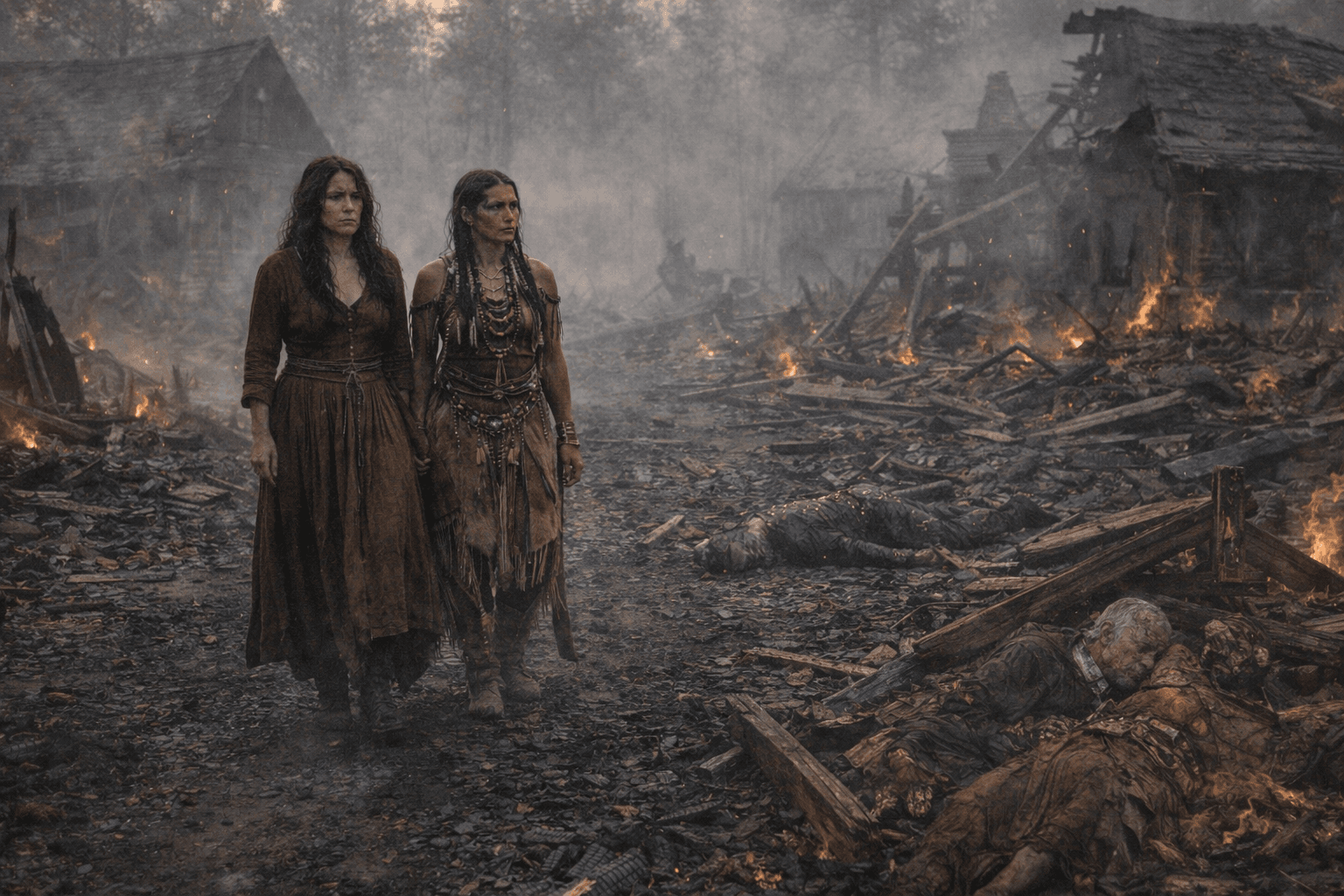
Bruised and sore, Mercy and Wáhkina stepped out from the shelter of the trees together, the pale light catching on drifting ash and broken wood. What had once been a village now lay open and hollow, as though something vast had passed through it and left nothing behind but memory.
Houses stood crooked or collapsed. The meetinghouse roof had fallen inward. The green was blackened, churned into mud and soot. Silence filled every corner.
They moved slowly, neither of them speaking at first.
They found Magistrate Crowe near the road, caught in the ruins of his authority. Mercy did not look long. She did not need to. The man who had wielded power over her life no longer held anything at all.
Pritchard and his wife lay together beneath the remains of their home, tangled in the wreckage they had once ruled, burned nearly beyond recognition. Mercy felt no satisfaction at the sight—only a strange, hollow calm.
“This is what fear makes,” she murmured. “This is what comes of mistaking cruelty for holiness.”
Wáhkina bowed her head.
They walked on.
Mercy’s cottage still stood on the outskirts of the village, near the forest. The fence was burned. The garden trampled. But the walls were whole. The door hung crooked, yet unbroken.
She let out a breath she did not realize she had been holding.
Inside the barn, Bess lowed softly. The goats stirred. The hens shifted in their roosts. Life, stubborn and ordinary, waited for her.
She set about feeding them, her movements slow and careful, as though she were afraid they might vanish if she looked at them too long.
Wáhkina watched her for a time, then turned toward the north.
“My father’s people are beyond the hills,” she said quietly. “They will take me in.”
Mercy looked up. “You’re leaving?”
Wáhkina nodded. “This land will not be safe for me now. Nor for you.”
“I don’t know what I would have done without you,” Mercy said. “You saved me.”
Wáhkina’s gaze softened. “You were not… like them.” She nodded her head towards the ruins of the village.
She lifted the cord from around her neck - a simple strand of braided sinew darkened with age, from which hung a small charm of polished wood and bone, worn smooth by years of touch.
She pressed it into Mercy's palm. Mercy glanced down to see the charm was shaped into the gentle curve of a leaf.
"The forest remembers kindness," she said softly. "And so do my people."
"Thank you," Mercy swallowed hard. “Will I see you again?”
“Perhaps,” Wáhkina said. “The world is wider than New Canaan, Mercy. You must find your place in it.”
They embraced briefly, awkwardly, two women bound by something that had no name.
Then Wáhkina turned and walked north, her figure soon swallowed by the trees.
Mercy stood alone beside her cottage, the weight of everything that had been lost—and everything that still remained—settling around her like mist.
When the sun dipped low, she went inside and brewed her tea—chamomile, mint, valerian—steam rising in the dim light. She sat at her small table, staring into the cup as though it might tell her where to go next.
She had no town.
No future.
No one left in the world she had known.
A sound came at the door.
The hairs along her arms rose as though the air itself had shifted. Her hand went to Tobias’s musket, the familiar weight grounding her as she crossed the small room, each step slow, deliberate.
She opened the door just a crack--
And the world seemed to tilt.
It wasn't possible, was it? And yet...
Caelith stood on her threshold.
Not as he had been.
He was taller now, broader through the shoulders, his presence filling the space as though the night itself had bent around him. Something glimmered beneath his skin, subtle but unmistakable—power held in check. His eyes shone brighter, deeper, as if he carried the memory of fire and shadow both.
He was no longer merely of the forest.
He was of something older.
“You look like you’ve seen a ghost,” he said softly.
Her breath left her in a broken sound. “How? This isn't possible. You were—”
“Not finished,” he replied. His gaze never wavered from hers.
She reached for him without thinking, her fingers trembling as they touched his sleeve, his chest, his face—warm, solid, real.
“They took you,” she whispered. “They—”
“The woman of the forest found my people,” he said quietly. “She told them what was done to me. They came. They brought my body back to Sylvarith.”
Mercy’s heart stuttered. “And you…?”
“I returned,” he said simply. “Fae do not pass as your kind do, Mercy. We can be broken, even bound to death’s door—but we are not so easily unmade.” His gaze softened. “What they did to me would have ended a mortal. It only changed me.”
He stepped closer, the lamplight catching in his eyes. “It made me stronger. Bound now to what I was always meant to be.”
“I am a gatekeeper,” he said. “Between worlds. Between what is and what is not. That has always been my fate.”
“And the village?” she asked.
His jaw tightened. “My people avenged me. Not in cruelty—but in balance. What was broken was set right.”
Silence stretched between them, thick with everything they had lost.
“My family has given their blessing,” Caelith said softly. “They know what you risked. What you lost. And they owe you a debt they will never forget.” A faint, reverent smile touched his lips. “So they have granted me the right to claim you—not as some mortal who strayed too close to the forest… but as my mate."
Mercy’s breath caught. “Your… mate?”
“To walk beside me,” he said. “To share my life. My duty. To stand with me at the gates between worlds.”
She searched his face, seeing only truth there. “And if I say no?”
“Then I will still love you,” he said quietly. “But I will not pretend the worlds have not already bound us.”
Tears welled in her eyes. “I don’t belong to New Canaan anymore.”
"You never did, Mercy." he murmured.
His gaze softened, though something vast still lived behind it. "Your path was set long before you ever knew how to walk it, Mercy. Long before your first breath ever touched the air. You were meant for more than the narrow life they tried to give you."
He lifted her hand, pressing it lightly to his chest. "You see what others cannot. You feel what they refuse to name. That is why you found me. And why I found you."
A quiet smile touched his lips. "That is why our fates have been bound together since the beginning.
He reached for her, careful this time, as though afraid she might fade if he touched her too suddenly. His fingers brushed her cheek. “Come with me, Mercy. Not to hide. Not to run. But to become something greater than either of us were alone.”
Her answer was not in words.
She rose on her toes and kissed him.
The world fell away as his arms came around her, strong and certain, and for the first time since the forest had taken everything from her, Mercy felt whole.
Somewhere beyond the shattered remains of New Canaan, the gates between worlds waited.
And together, they would guard them.
____________________
The Lament of New Canaan
They say New Canaan stood where the trees grow thin,
Where prayer was loud and mercy scarce,
And the people feared what they could not name.
They say the forest watched that town,
Old and patient as the earth itself,
Waiting for truth to be spoken aloud.
There lived a woman called Mercy Hale,
A widow with eyes like burning gold
And a faith too deep to fit inside their walls.
She loved where she was told not to.
She walked where she was forbidden.
And for that, they named her wicked.
When the fires were lit and the ropes were drawn,
The forest answered at last.
And New Canaan fell to ash and silence,
Its name swallowed by time and root.
But Mercy did not burn.
They say the fae claimed her that night--
Not as prisoner, nor as sacrifice,
But as one of their own.
She crossed the threshold that never stays still
And became what no Puritan could bind:
A keeper of the gates between worlds.
Some swear she still walks the green places,
Hand in hand with a pale-haired fae
Whose eyes hold both sorrow and fire.
And if you wander too near a forest’s edge
When the air grows thin and the shadows listen,
You may feel them watching--
Mercy Hale and her immortal love,
Guarding the door between what is
And what must never be lost.
So mind the old woods, child.
Not all fires are holy.
And not all love is meant to die.