The Widow At The Forest's Edge ~ Part 2
The forest changed the moment Mercy crossed the boundary.
Caelith did not release her hand. His fingers remained laced through hers as he led her forward, his grip steady and warm, anchoring her even as the forest shifted around them.
The air deepened, cool and alive, carrying the scent of damp earth and leaf and something older beneath it. The sounds of the world she knew thinned behind her, replaced by the quiet breathing of living things. The ground softened underfoot, rich and dark, as though it remembered rain long after the sky had cleared.
She tightened her grip on his hand without realizing she’d done it.
Caelith glanced back once, his blue eyes flicking to her face. He said nothing, only squeezed her fingers in return, as if to say there’s nothing to fear in this place.
They moved deeper.
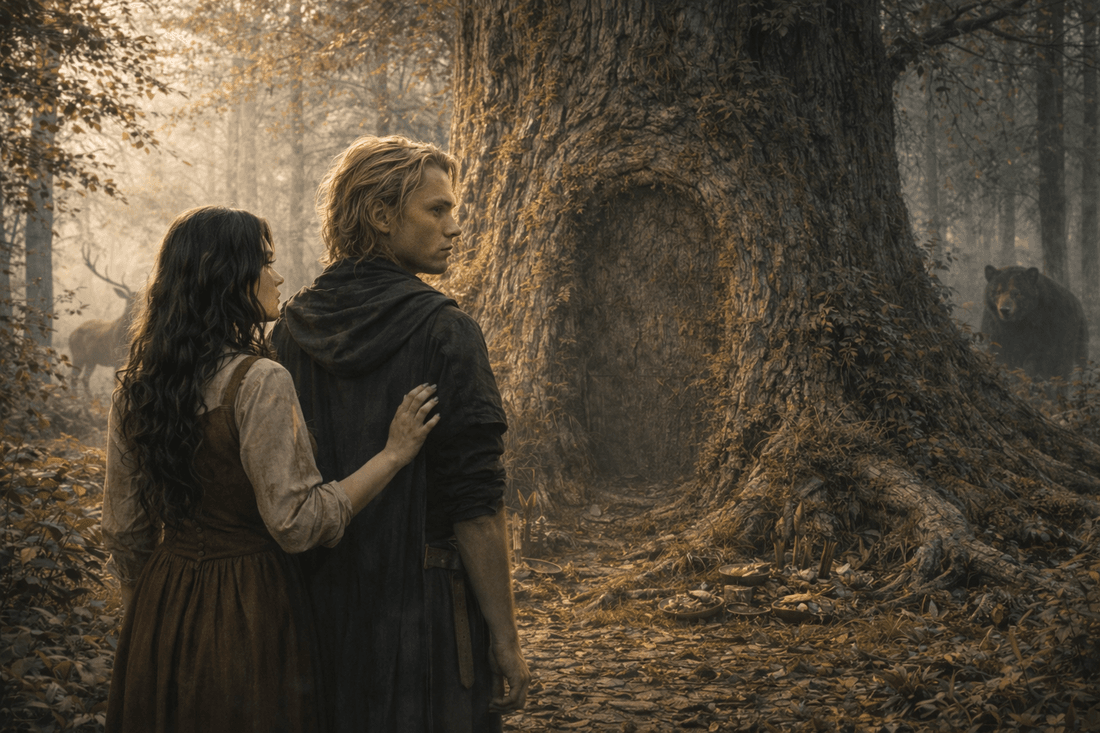
Light filtered differently here—slanted and green, catching on bark and moss and the low sweep of branches heavy with early leaves. A stag stood just off the path, massive and unafraid, its antlers pale against the shadowed trees. It watched Caelith approach, then dipped its head once, slow and deliberate, before stepping aside to let them pass.
Mercy’s breath caught.
Other creatures lingered in the periphery—fox slipping through brush, wild turkey rustling the undergrowth, a black bear far off among the trees, unconcerned by their presence. None fled. None challenged them. They watched, as though they knew who walked among them.
As though they knew him.
She noticed signs then—small, deliberate marks along the way. Stones set in quiet stacks. Branches bent and tied with woven cord. Small offerings left at the base of trees, placed with care rather than haste.
“Do others come here too?” she asked softly, nodding toward the items scattered along the trail.
Caelith inclined his head. “Some do. Though none of them are from your village.”
“It must be the native people,” she said after a moment of thought. “I’ve seen marks like these near the river.”
“Yes. Those who knew this land before it was named and divided.” he replied. “They understand living places better than the colonists ever could. They have coexisted with this forest for many, many years.”
He glanced toward the trees as they passed, his expression unreadable. “They respect it. That is different from fearing it. And they do not fear me, either.”
She studied him then, unsettled by the certainty in his voice. “You speak of them as friends.”
“They are,” he said simply.
The ease of his answer unsettled her more than the forest ever could. Only then did she realize how little she truly knew of the man leading her deeper into a place her people had feared for generations.
They went on a few moments more, the forest shifting around them as though it chose when to allow passage. Then they stopped before a tree so immense Mercy could not see its crown. Its trunk was wide enough to consume a small cottage, the bark ancient and deeply ridged, choked with vine and leaf.
Caelith stepped closer to the tree, never releasing her hand, and brushed the hanging foliage aside. Set into the great trunk—narrow and nearly hidden in a deep crevice—was a door. It was arched and slender, its surface worn smooth as though touched by countless hands over centuries. It did not look made, but grown—dark wood pressed into darker wood, seamless and old.
“Is this where you live, Caelith?” Mercy asked, unable to keep the disbelief from her voice. “Inside a tree?”
He glanced at her, a faint curve at the corner of his mouth. “It’s one way in.”
He lifted his free hand and pressed it against the door.
It opened without a sound.
Light spilled through—cool and strange, threaded with green and gold. Mercy felt it before she truly saw it, a low hum beneath her skin, a gentle pressure, as though something on the other side had become aware of her presence and was considering what to do with it.
Caelith stepped forward, drawing her with him.
She did not resist.
The world behind them loosened its hold and fell away.
They passed through the doorway. Mercy had expected the hollowed interior of the tree, roots closing in around them. Instead, she found herself standing beneath a sky woven of luminous branches arcing impossibly high, leaves glowing softly as though lit from within. The forest here bore a passing resemblance to the one she just left behind, but the likeness ended quickly.
The air shimmered with life, rich and sweet, carrying the distant sound of water and voices too soft to make out. Structures rose ahead of them—formed of living wood and vine, elegant and unnatural, grown rather than built. Pathways curved and wound through the land as though they had chosen their own course, untouched by human hand.
Mercy’s heart raced, awe and fear braided tight in her chest.
Caelith watched her closely, his grip firm and steady around her fingers. “Whatever you do,” he said quietly, “do not wander from me. Stay close. At all times.”
She swallowed hard. “What is this place?”
“You stand in the Kingdom of Sylvarith now,” he replied. “Under the keeping of the Court of Deepwood.”
“I don’t understand,” Mercy murmured, instinctively stepping back, her gaze darting toward the doorway behind them—the forest she knew, the world that made sense. “How can this be possible, Caelith? What manner of witchery is this?” Her voice dropped. “Have you done something to me? Am I seeing things?”
She didn’t wait for his answer.
“My people have always feared the forest,” she said, slower now, choosing her words. “They warn their children from it. They speak of things lost there, of men who went too far and did not return.”
Her gaze drifted back to the living structures rising among the trees, wonder and unease warring in her expression. She lifted her hand, pointing toward the tower grown into the side of the immense tree, its height vanishing into the glowing canopy above.
“But those who have ventured inside—hunters, woodcutters, even the boldest among them—never spoke of this,” she went on. “Never of cities. Never of places built and living side by side with the forest.”
Caelith followed her gaze, then looked back at her, his expression unreadable.
“That,” he said softly, “is because they were never meant to see it.”
Caelith did not elaborate further. He only turned and guided her forward again, his grip steady, as though the matter were settled. Mercy decided that she had no choice but to trust him.
They followed a path that sloped gently, winding through trees that felt older than the forest she had left behind, their roots thick and exposed like the bones of the land itself. Mercy expected distance—miles, perhaps—but instead there was only a short, quiet stretch before they reached their destination.
She began to sense it before she saw it.
The trees thinned.
And then the land fell away.
Mercy stopped short, her breath leaving her in a rush.
Before them, a vast ravine, its stone walls veined with green and silver, shaped by water and the slow, deliberate hand of time. Nestled within its depths was a city—not raised upon the land, but drawn from it, as though the ravine itself had decided to bloom. Terraces of living wood and stone curved along the rock face, their lines graceful and organic, while bridges arced between them like thoughts made solid. Light drifted through it all, warm and constant, spilling from windows and pathways, pooling softly in the shadows, as though the city breathed and welcomed those who dared to look upon it.
Mercy felt the pull of it then—quiet, insistent. It was unlike any city she had ever known. Not that she had seen many in the colonies, but she had grown up on her parents’ stories and the few treasured sketches they had carried across the sea—London, York and Bath, cities of stone and smoke, of straight lines and human striving.
This place bore no such marks.
She could not speak.
Caelith slowed beside her. “This is where the gate is watched,” he said, gesturing around the cliffside where they stood. “And where my family keeps its vigil.”
Only then did she notice the house.
It stood just above the ravine’s edge, set back from the path, overlooking both the city below and the narrow place in the land where worlds touched. It was grand without ostentation, three stories tall, its shape drawn from the rock and the trees themselves, as though it had risen there because it had always belonged.
What looked to be armored guards stood near its entrance.
They watched her.
Not with curiosity, but with assessment.
A blond man stepped out from the house, his stride long and unhurried, his resemblance to Caelith unmistakable. He made directly for them, a smile already tugging at his mouth.
“So,” he said lightly, eyes flicking between them, “you finally did it, brother.” His gaze lingered on Mercy, slow and assessing. “I told Father you wouldn’t have the restraint to keep her on the other side forever.”
His attention sharpened as he looked her over, openly curious, entirely unashamed. Mercy felt heat rise to her cheeks beneath his scrutiny.
“Well,” he added with a low whistle, “I can’t say I blame you. She’s a fine thing.”
Caelith’s grip on Mercy’s hand tightened.
“Mind your manners, Aerin,” he said coolly. “You stand in her hearing.”
Aerin laughed, wholly unbothered. “Forgive me. I forget how protective you become once you’re attached.” His gaze returned to Mercy, softer now, though no less piercing. “You’ve certainly stirred trouble, human.” He laughed again. “And since my brother has forgotten his manners and failed to introduce us properly, I am Aerin—Caelith’s older brother.”
Then his expression shifted, amusement giving way to something more cautious. He leaned closer to Caelith, voice lowering just enough.
“You’d best take her back through the gate,” Aerin murmured. “Before Mother sees her.”
Caelith’s jaw set.
“She won’t take kindly to this,” Aerin went on, a teasing note creeping back in. “You know how she is. Still holds to the old ways. Humans make her… testy.”
His smile widened. “And she’s never been fond of surprises.”
Caelith didn’t respond to his brother’s prodding.
He guided Mercy past him without a word, his hand firm at the small of her back as he led her along the side of the house. Stone gave way to earth beneath their feet, the grandeur of the front falling behind them as though deliberately left unacknowledged.
“Aerin is right. My mother will need… time,” Caelith said at last, his voice low. “She does not take well to surprises. Especially human ones.”
Mercy glanced back once, catching sight of Aerin still watching them go, amusement lingering in his expression. The look unsettled her. There was something too easy in it. Too familiar.
They passed beneath a carved arch and into an orchard that stretched farther than she would have guessed from the path alone. Trees stood in loose, natural rows, their branches heavy with fruit—apples, pears, figs, shapes she recognized though the colors were brighter, deeper, as if painted by a steadier hand. Everything here seemed fuller. More alive. The air was sweet with ripeness.
She slowed despite herself, brushing her fingers along the smooth curve of a fruit that glowed a warm, unfamiliar gold. “This looks like nothing I’ve ever seen,” she murmured.
Caelith glanced at her. “That is often the way of things here, Mercy. Much of what exists in my world has never had a name in yours.”
They walked on a few steps in silence. Mercy’s thoughts churned. The house. The man who had called Caelith brother. The easy way they spoke of a mother who sounded very much alive—and very much in command.
“You have a family,” she said at last. It was not a question.
“Yes.”
The word carried more weight than she expected.
“How many siblings do you have?” she asked quietly.
Caelith slowed, then stopped beneath the shade of a broad-leafed tree. “Four brothers,” he said. “And three sisters. Besides myself.”
The number made her chest tighten.
“That’s… a great many,” she said, the words catching as her thoughts drifted to her own small, quiet life. To parents taken by the plague only months after her marriage. To siblings who had never survived long enough to be remembered as adults. To a cottage that had grown too still after Tobias’s death. And to a loneliness she had carried for years without ever allowing herself to name it.
“It is,” he agreed. His gaze returned to her, searching. “And it is why they notice when something is… out of place.”
She hesitated, then voiced the question that had been pressing against her ribs.
“Aerin called me human,” she said. “As though it were something separate.” She lifted her eyes to Caelith. “Aren’t you human too?”
He stopped fully then, turning to face her.
The orchard seemed to still around them, leaves stirring though no wind passed through.
“You truly don’t suspect, do you?” he said quietly. “Not even after everything you’ve seen.”
Her pulse quickened. “Suspect what?”
He held her gaze for a long moment, as though weighing what could no longer be withheld.
“I am not human, Mercy.”
The words were plain. Unadorned. Impossible to mistake.
“I am fae,” he said. “And so are my family... and everyone else here in Sylvarith."
The word settled heavily between them.
Fae.
Mercy’s breath caught. Not in wonder—but in fear.
She had heard the stories. Not spoken of openly, but passed down in lowered voices, wrapped in warning. Things that wore beauty like a mask. Deceivers. Demons that led men astray. Fallen angels, some said—cast down but not destroyed, lingering where God’s light did not reach.
Her gaze slid away from Caelith, taking in the orchard again with new eyes. She recalled the careful placement of stones she had seen along the forest path on their trek to the gate. The woven cords. The small offerings left at the roots of trees.
Not superstition.
Reverence.
The natives had not been warding the forest away.
They had been honoring it. Seeking the blessing of the fae.
And him.
Her pulse quickened. The sweetness of the air felt suddenly cloying, the glow too warm, too close. She stepped back, the distance between them widening by a single pace.
“You should have told me,” she said, though her voice wavered despite her effort to steady it. “My people… we were taught—” She faltered, swallowing hard. “We were taught that such beings were not to be trusted. That they weren’t even real. Just stories meant to frighten children into obedience.”
Caelith did not step closer. She noticed that, too—how carefully he held himself still.
“You were taught my kind did not exist,” he said quietly. “Or worse—that we were demons wearing fair faces. I know what the Puritans say, Mercy.” His gaze held hers, unwavering. “And knowing that, you still wonder why I did not tell you.”
The words were not sharp. They did not need to be.
They cut all the same.
She drew a breath, steadying herself. “Please,” she said, the word barely more than a whisper. “Take me back. I should not be here.”
For a moment, she thought he might argue.
Instead, he inclined his head.
“As you wish,” he said. “But know this, Mercy—what you have seen cannot be unseen.”
Caelith led her back the way they had come, the orchard falling away behind them. Mercy had taken only a few steps when voices rose ahead—low, urgent, edged with anger held in careful check.
Aerin stood near the path with two others. They were unmistakably older than him. Not in the frailty of years, but in the weight they carried. The woman was tall and pale, her golden hair swept back from a face carved in cool lines. She did not raise her voice, yet it carried.
“You knew better,” she was saying. “You of all of us knew better. Why did you not tell me?”
Aerin’s mouth tightened. “He crossed alone. I had nothing to do with this, Mother."
“But you knew what he was doing in that pathetic world, and you let him bring her here—into our home?” the woman snapped. “Have you learned nothing from what is happening in the Ten Kingdoms even now? Valoria still bears the scars of their wars.”
They all turned as one when Caelith approached.
The woman’s gaze moved to Mercy and stopped. There was no curiosity in it. No wonder. Only hostility.
“Take her home,” she said to Caelith. “Now. The humans beyond the gate are no kinder than those already stirring trouble in Valoria—and you know exactly what that leads to.”
Caelith’s stepped closer to Mercy, his arm sliding protectively around her shoulders. “Mother—”
“No.” The word fell like a blade. “No good has ever come of bringing humans into our lands. You know this.”
The man beside her—tall, broad-shouldered, dark hair streaked through with gray—said nothing at first. His gray eyes lingered on Mercy, searching her face as though weighing something unseen. They could have been kind eyes - in another setting.
“That’s enough, Nyssara,” he said quietly. “You can see she’s frightened.”
The woman’s jaw clenched. “Fear does not change what she is. She does not belong here.”
Mercy’s throat tightened. She did not look away.
“We will not repeat Valoria,” the woman continued. “Not for love. Not for curiosity. Not again.”
Caelith’s shoulders stiffened. “Then you may find some comfort in this,” he said evenly. “She has no wish to remain here.”
He turned then, guiding Mercy away. The orchard folded in behind them, the light of the city sinking into the ravine as they walked, its warmth dimming until only shadow remained. Silence pressed close on all sides.
Mercy’s chest tightened, each breath drawn with effort. She felt the tears gathering—the familiar ache rising in her throat, heavy and inevitable.
The gate appeared ahead, the great tree standing patient and watchful.
Only when they stood before it did she pull her hand free.
“You mustn’t come to me again,” she said, the words shaking despite her resolve. “Whatever this is—it’s too dangerous. For you. For me.”
Caelith’s expression fractured, just briefly. “Is this truly what you want?”
“No,” she whispered. “But it’s what I need. It’s for the best. Our worlds were never meant to collide, Caelith.”
The door opened at his touch.
He stepped aside to give her room, though his gaze stayed fixed on her, as if letting her go cost him something he hadn’t planned on losing.
“I won’t stop you,” he said quietly. “If you need to go, then go.”
His voice dropped, rougher now. “But don’t mistake distance for an ending. Some things don’t loosen just because you step away from them.”
He hesitated, then reached for her, laying his hand over her heart—brief, deliberate, as though he feared what might happen if he lingered.
“This,” he said softly, “whatever has taken hold here—it does not belong to your world or mine.” His thumb pressed once, gentle and sure. “It belongs to us.”
His gaze held hers, unguarded now. “If you ever need me, Mercy—truly need me—you won’t have to call aloud.” A pause. “I will know.”
Tears burned behind her eyes. She did not trust herself to speak.
She stepped through the threshold.
The forest of her world closed around her, quiet and suddenly too small. When she turned, the doorway was gone—only bark and leaf remained, seamless and silent.
She made it home in a daze.
Her cottage greeted her with its stillness—too quiet, too empty. She shut the door and sagged against it, breath leaving her in a rush, her knees trembling beneath her. Somehow she made it to the bed, but no farther. She collapsed onto the quilt as the last of her strength gave way.
And then she wept—deep, broken sobs she could not stop. Grief, fear, longing—each braided so tightly together she could no longer tell where one ended and the next began.
She had been taught that desire was a snare. That longing led only to ruin. That some attachments damned the soul.
Yet as the night pressed in around her, one terrible truth took hold:
A part of her would rather face perdition itself than never see his face again.
__________________________________________
The pounding came hard and sudden, startling her from sleep.
Mercy gasped awake, heart already racing, the echo of it still ringing in her bones. For a fleeting, foolish moment, hope stirred—an image of golden hair and familiar eyes rising unbidden to her mind.
Caelith.
She pulled on her shawl and crossed the room, still unsteady, the floor cold beneath her bare feet. The knocking came again, sharper now. Insistent.
She opened the door.
Three men stood on her threshold.
Magistrate Samuel Crowe occupied the center, his broad frame blocking the morning light. Reverend Pritchard stood just to his right, lips already drawn tight with judgment. And behind them—half a step back, as though unsure of his place—stood a man Mercy recognized only in passing.
Her stomach turned.
He was tall but poorly made, all angles and narrowness, his limbs too long for his body, his shoulders hunched forward as though trying to disappear into himself. His face was sharp-featured, nose thin and hooked, mouth small and pinched. His eyes—tiny, dull, and colorless—flicked over her in a way that made her skin crawl.
Mercy realized, with a flush of cold, that she stood before them with her hair loose, dark and tangled from sleep, her shift wrinkled beneath the shawl. She had not thought to smooth herself. Had not thought at all.
Crowe’s gaze swept over her once, slow and assessing. Pritchard’s eyes darted past her shoulder, peering into the cottage beyond.
“You are alone?” the reverend asked.
“Yes, of course I am.” Mercy said, though her voice felt thick, unused. “What is this about?”
Crowe glanced past her as well, his eyes taking in the quiet room, the cold hearth, the bed visible beyond. Something like satisfaction flickered there.
“We have received troubling reports,” Crowe said evenly. “Of impropriety. Of conduct unbecoming a godly woman.”
Pritchard stepped forward. “You have been seen in the forest. With a man. The same man who disrespected me the last time I paid you a visit.”
Mercy’s heart lurched. “I—”
“He’s a wild, wicked man,” the reverend continued, his voice sharpening. “One who does not belong to this community. One who does not submit to God’s order.”
The third man shifted then, stepping forward at Crowe’s subtle nod.
“This is Ezekiel Weatherford,” Crowe said. “A widower. A man in good standing. Industrious. God-fearing.”
Weatherford’s thin mouth twitched, attempting a smile. It only made him look hungrier.
“He is willing,” Crowe went on, “to look past your… lapse. To offer you protection. Respectability. Marriage.”
The word struck Mercy like a blow.
“Today,” Pritchard added. “Before this matter spreads further.”
Mercy stared at them, her pulse roaring in her ears. “You accuse me of sin,” she said slowly, “and call this mercy? Marrying me off to a man I don’t even know?”
Weatherford’s eyes slid over her again, lingering on her throat, her hair. “A woman alone invites trouble,” he said, voice thin and reedy. “A husband would fix that.”
Something inside her recoiled violently.
Crowe folded his hands. “This is an opportunity, Mistress Hale. One we are not required to extend.”
Pritchard leaned closer, his breath sour. “Refuse, and we must pursue this matter… formally.”
The cottage felt suddenly smaller. The walls too close. Mercy’s fingers curled into the edge of the doorframe as she stood there, bare and shaken, realizing with sick clarity that they had not come to ask.
They had come to claim.
And somewhere, deep beneath the fear, a single thought burned—dangerous and unyielding.
If Caelith were here…
The thought came unbidden—and Mercy forced it away just as quickly.
He was not here. She had seen to that herself.
This was her doing. And as she had faced every other loss in her life, she would face this one alone.
Mercy drew a slow breath, schooling her features, pressing her anger down until it sat heavy and contained in her chest. She knew these men. Knew the danger of meeting them with open defiance. She’d already been defiant enough.
“Thank you,” she said carefully. “For your concern.”
All three men looked at her then.
“I am grateful,” she went on, steadying her voice, “that you would think to see me settled. But I cannot agree to such a thing… not this moment.”
Pritchard’s brow furrowed. “And what, precisely, is there to consider?”
“I must pray on it,” Mercy said. “Marriage is no small covenant.”
The reverend’s mouth thinned. “There is no need for prayer when the Lord’s will is already plain.”
Mercy met his gaze and did not look away. “Perhaps. But it would still be a sin to enter into it without seeking His guidance.”
Crowe watched her closely, weighing. After a moment, he inclined his head.
“Very well,” he said. “You will be given time.”
Weatherford looked less pleased, his narrow face tightening, but he said nothing.
They turned to leave.
Then Pritchard paused on the threshold.
“One more thing,” he said, not looking at her. “Your farmstead.”
Mercy’s stomach clenched.
“Others suffer,” he continued. “Cattle dying. Fields failing. And yet yours flourishes.”
Crowe turned back then, his gaze sharp. “Such imbalance invites scrutiny. What forces have you made a pact with that have spared your farm whilst the rest of us suffer?”
Mercy’s fingers curled in her sleeve. “I’ve done nothing unlawful.”
“So you say...” Pritchard murmured accusingly.
He glanced once toward the tree line beyond her cottage, where the forest stood dark and watchful even in daylight. “Such things suggest influence.”
Pritchard met her gaze. “And the man you consorted with will be questioned in that regard. Thoroughly. We are already on the lookout for him.”
Crowe’s voice followed, low and final. “See that you remain within the bounds of this town, Mistress Hale. For your own good.”
They turned then, boots thudding against the packed earth as they mounted their horses. Mercy watched from the doorway as they rode away together—Crowe at the center, Pritchard stiff-backed beside him, Ezekiel Weatherford trailing close behind. Each of them cast glances toward the forest as they went, searching the tree line, as though they half-expected Caelith to step out from the shadows.
As though they were already hunting him.
When they were finally swallowed by the road’s bend and the trees beyond, Mercy closed the door.
The sound echoed too loudly in the empty cottage.
She pressed her back to the wood and slid down until she sat on the floor, her hands flying to her mouth as a scream tore free—raw and unrestrained, ripped from somewhere deep and breaking. It filled the small space, bounced off the walls, and fell back on her until there was nothing left but breathless silence.
No one came.
No one could.
Mercy folded in on herself, the weight of it settling heavy and absolute.
For the first time since Tobias’s death, she did not know how she was meant to endure what was coming next.
And she had never felt more alone.
____________________
The days that followed settled into a quiet, punishing rhythm. Mercy rose with the light, brewed her tea, and tended what little remained hers—Bess, the two goats, the hens. She planted a small garden near the fence, her hands in the soil, her eyes always lifting toward the forest as though she might catch movement there if she looked long enough.
One morning, when thoughts of Caelith would not loosen their grip, she ventured beyond her land. She waited until the road lay empty, until no eyes lingered, and then slipped into the trees. She moved carefully, following the path she remembered, heart hammering as the forest thickened around her. When she reached the great tree at last, its vast trunk loomed as it always had—ancient, ridged, wrapped in vine and shadow.
But the door was gone.
She searched the bark where it had been set, brushed aside leaves and creeping moss, traced the grooves with trembling fingers. There was nothing. No seam. No arch. No sign it had ever existed at all.
Mercy stepped back, her breath shallow. She did not understand how such a thing could simply vanish—but then, she understood very little about the fae, or the rules by which their world bent and shifted. The tree stood silent and indifferent, as though it had never opened itself to her at all.
She returned home with her heart heavy and unanswered.
As spring gave way to summer, she returned to meetinghouse worship and kept her head bowed, her voice steady in prayer. She did it to keep suspicion at bay, but it did little to soften the town. Women turned away. Men watched her too closely. Whispers followed her down the aisle like a second shadow.
For the time being, she managed to keep Elijah Weatherford’s proposal at bay. When Reverend Pritchard pressed her, she spoke carefully, telling him there was a weight upon her spirit she could not yet name—something she was carrying before God in fasting and prayer. She dared not enter a marriage covenant while her heart remained unsettled. Such language satisfied him. No godly man would argue with a soul seeking divine clarity.
So Mercy waited. Fasted when she was meant to. Prayed when she was watched.
And always, her eyes returned to the forest.
Thus her days settled into a careful sameness, each one endured rather than lived—until one Sunday, when the stillness turned against her.
The meetinghouse was full.
Mercy felt it the moment she stepped inside—the way voices fell quiet, the way eyes tracked her progress down the aisle. She took her place near the back, folded her hands, bowed her head.
The sermon passed like a storm cloud—sin, disorder, judgment. Reverend Pritchard’s voice rose and fell, heavy with warning.
When it ended, no one moved.
Pritchard did not close in prayer.
Instead, he placed both hands on the pulpit and looked directly at her.
“Before we part,” he said, “there is a matter that must be brought into the light.”
A murmur stirred the benches.
“Certain sins,” he continued, “thrive in shadow. They corrupt not only the soul, but the body of the faithful.”
A cold knot of fear tightened in Mercy’s stomach, sudden and sickening.
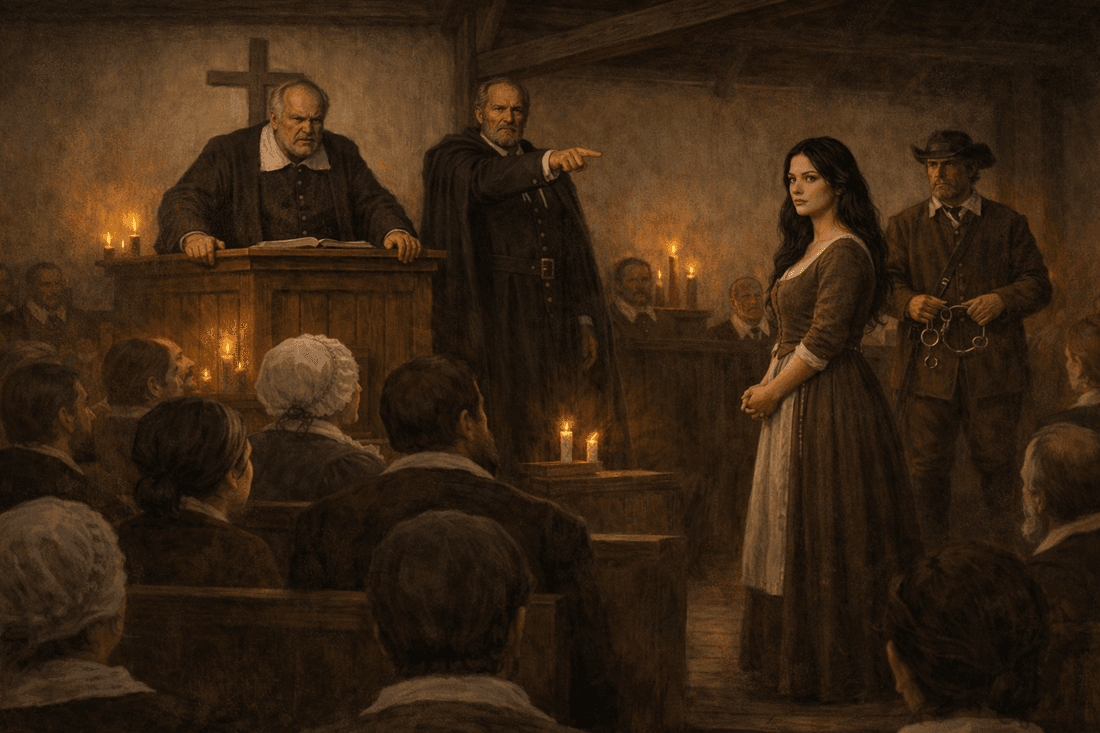
Magistrate Crowe stood then, his presence commanding silence. “Mercy Hale,” he said evenly. “You are called to answer.”
She rose slowly, every eye upon her.
“You have been seen in the forest,” Crowe went on. “Alone. In the company of a man not of this town.”
A ripple of breath moved through the room.
Pritchard’s voice followed, sharp and unyielding. “A woman widowed is not without temptation. And yet you have resisted godly correction. You have refused marriage. You have invited disorder.”
“I have invited nothing,” Mercy said, her voice trembling but clear. “I have done no wrong. I have been seeking God these past months. My only desire is to please Him.”
“And yet,” Crowe said, “your household prospers while others suffer.”
The word witchcraft did not need to be spoken aloud.
It hovered in the air, heavy and inevitable.
“You have been accused,” Pritchard said, “of unnatural influence. Of consorting with forces beyond God’s design. Of immorality.”
Mercy felt the floor sway beneath her. “No, this cannot be,” she said. “None of these accusations are true.”
Crowe’s expression did not change. “It is caution.”
He nodded once to the constable.
“For the safety of this town,” he said, “you will be held until these matters can be examined.”
Rough hands closed around her arms.
She was led not from the meetinghouse, but downward.
A narrow door beside the pulpit was opened, revealing stone steps that plunged beneath the floorboards where, moments earlier, the Word had been preached. The air turned cold and damp as she was led downward, each step carrying her farther from the light. Whispers trailed after her—hushed, fervent, hungry—slipping through the cracks of the meetinghouse and following her into its depths.
The guardroom was small and unforgiving. Rough timber walls closed in tight around a single bench. Iron cuffs were bolted into the stone, dull with age. A lantern hung from a hook overhead, its flame weak and wavering, casting shadows that refused to hold their shape.
They bound Mercy to the cuffs like she was a common criminal.
Then the door shut behind her.
The sound rang out, final and unmistakable, echoing through her bones.
Mercy stood alone beneath the meetinghouse, the weight of accusation pressing down through the beams above her. Fear settled deep in her chest—but beneath it, sharp and undeniable, burned a single truth.
They believed the forest was the source of their suffering. That the forest hid Caelith.
And they would not stop until they tore it open.
Her breath trembled as she lowered herself to the cold floor. In the dark, with no one left to witness her, she spoke the name she had sworn to release. “Caelith. I need you.”
____________________
Night came heavy and moonless.
Mercy had long since lost any sense of time when the sound reached her—not the scrape of boots or the rattle of keys, but something softer. A shift in the air.
The lantern flickered.
Then the guardroom door opened.
One of the guards barely had time to turn before an arrow struck him cleanly through the throat. He fell without a sound. The other reached for his blade, panic widening his eyes—only to be seized from behind, a hand clamped over his mouth, a knife flashing once in the dark.
Silence followed. Sudden. Absolute.
Mercy did not scream. She knew.
The shadows parted, and Caelith stepped into the lantern’s weak glow.
Relief hit her so hard her knees nearly buckled.
He was not alone. Others moved behind him—tall, pale shapes with the same quiet, lethal grace. Fae. And beyond them, half-seen in the doorway and the stairwell above, were figures Mercy recognized by posture and presence rather than dress: the native people of this land, faces solemn, eyes watchful, as if this were not rescue but duty.
Caelith crossed the room in three strides and knelt before her, his hands warm and steady as he cupped her face.
“Are you hurt?” he asked, his voice low, urgent.
She shook her head, tears spilling despite herself. “Oh Caelith, I knew you’d come.”
“I told you I would.”
He broke her cuffs as though they were no more than twine, then pulled her into his arms. She clung to him, breath shuddering, grounding herself in the solid truth of him.
They did not linger.
They left the meetinghouse without further resistance, slipping into the night as quietly as breath. The forest closed around them at once, branches and shadow swallowing the path behind. Mercy stayed close to Caelith’s side, his arm firm around her as they moved through the trees like phantoms, unseen and unchallenged.
Time lost its meaning beneath the canopy. The forest stretched on, dark and alive, until at last the trees parted into a small clearing warmed by firelight. An encampment lay tucked deep within the woods—canvas and hide shelters arranged with deliberate care, smoke rising thin and steady into the night air.
The native people there greeted Caelith with nods and low murmurs, words Mercy could not understand. Yet their meaning was clear enough. There was no fear in their faces. No suspicion. Only recognition. Acceptance settled over her like a cloak she had not known she was missing.
They guided her to the fire and wrapped her in a heavy woven blanket. Someone pressed a wooden bowl into her hands—thick corn porridge sweetened with crushed berries, warm and sustaining. Another offered roasted venison, sliced thin and salted, the meat rich and grounding. She ate slowly, each mouthful easing something tight and hollow inside her.
Gentle hands checked her wrists, her arms, her throat for injury. Soft voices murmured over her, steady and reassuring, though the words themselves were unfamiliar. Mercy let herself sit, let herself breathe.
For the first time in longer than she could remember, the ache of loneliness loosened its hold.
And she did not feel alone at all.
Later, wrapped in furs beside a low fire, Mercy traced the lines of Caelith’s chiseled face as if memorizing him.
“There’s no place for me in New Canaan anymore,” she said softly. “Even if I returned… I would never belong. Not after this. They’d not let me live.”
Caelith reached for her,, pulling her close. “Then don’t return,” He whispered. “I won’t allow it, Mercy.”
She looked up at him, eyes bright with fear and longing. “I don’t know how a human and a fae are meant to—” Her voice faltered. “I only know I want to be with you. However that looks.”
He exhaled slowly, resting his forehead against hers. “My father stands with me. He understands what you are—and what you could be.” A pause. “My mother will resist. She fears history repeating itself. But she will come around. She always does.”
Mercy swallowed. “And the gate?”
“I am bound to it,” he said. “Every gate has a keeper. This one is mine. There are others—across lands and oceans, woven between worlds. All of them watched. All of them fragile.”
She absorbed that in silence, the weight of it settling deep.
Dawn crept pale and quiet through the trees. Caelith kissed her then—slow, reverent, devastating in its tenderness.
“For now,” he said against her lips, “this is enough.”
She knew, even as she held him, that it would not last.
But for one night—one stolen, sacred night—it was everything.
____________________
Mercy woke to stillness.
The fire had burned low, embers glowing dully beneath a skin of ash. Dawn pressed pale and uncertain through the trees. Caelith slept beside her, sitting upright with his back against a fallen log, head bowed slightly as though even rest had not fully claimed him. One arm lay loose at his side, close enough that her fingers brushed his sleeve when she shifted.
She smiled faintly.
Then she noticed the silence.
The encampment was empty.
The shelters stood as they had the night before, but there were no voices, no movement, no soft footfalls beyond the firelight. The people who had watched over them were gone. Mercy pushed herself up, her breath catching as she scanned the clearing.
That was when she saw them.
Bodies lay scattered near the fire—still, dark shapes half-shadowed by morning light. Blood soaked into the earth. Throats cut cleanly. Mercy’s stomach dropped, cold and hollow, the scream rising and dying in her chest.
She reached for Caelith.
Before she could touch him, a voice broke the quiet.
“Mercy, step away from that demon.”
Men emerged from the trees—too many. Reverend Pritchard first, his face pale and tight with righteousness. Magistrate Crowe beside him, grim and resolved. And Elijah Weatherford, eyes bright with something eager and unwholesome. Behind them came others—hunters Mercy recognized, men who passed through the village season after season, muskets raised, expressions hard.
Caelith moved before Mercy could draw breath.
The air around him snapped tight, as though the forest itself had drawn inward. Light flared along the faint sigils etched into his arms - sigils Mercy had never seen until now—gold-green and pulsing, alive beneath his skin. Leaves trembled. The fire guttered low.
“Do not come any closer,” he warned softly.
They came anyway.
Caelith lifted one hand.
The ground answered.
Roots burst from the soil, coiling fast and brutal around a hunter’s legs. He screamed as they crushed and dragged him down, the sound cutting off abruptly as his head struck stone. Another man lunged forward, blade raised—only to be flung backward as if struck by an unseen force. He hit a tree hard enough that Mercy heard bone give way.
Blood spattered the ground.
Caelith was everywhere at once—moving with terrible precision, shadows bending to his will. A man reached him from behind; Caelith turned, seized him by the throat, and slammed him into the earth. The hunter convulsed once and went still.
Elijah Weatherford shouted and charged.
Caelith met him head-on.
There was a sickening crack as Weatherford was thrown aside, his body folding wrong as he struck the ground. He did not rise again.
Mercy staggered back, hands clutched to her mouth, heart hammering so hard she thought it might split her apart.
She turned just in time to see movement near the fire.
One of the hunters still lived.
He lay sprawled in the dirt, his stomach torn open, intestines exposed and blood soaking dark into the earth beneath him. His breath came in wet, ragged pulls, each one sounding more impossible than the last. With shaking hands slick with his own blood, the man dragged a musket toward him.
Mercy screamed. “Caelith, look…”
She was too late. The shot rang out.
Caelith cried out as the iron bullet tore into him, his body jerking hard with the impact. Blood spilled down his side, dark and sudden. The light along his arms faltered, flickering like a flame starved of air.
Before he could recover, another shot split the morning.
Reverend Pritchard stepped out from behind one of the canvas shelters, musket already smoking. His face was pale, eyes bright with a terrible certainty.
“Hold fast,” Pritchard called. “Do not relent.”
Caelith staggered, another iron wound blooming across his chest. He dropped to one knee, breath tearing from his lungs, the forest’s answering hum falling away into stunned silence.
They rushed him then.
Magistrate Crowe and one remaining hunter seized him, iron cuffs snapping shut around his wrists. Chains followed, heavy and unforgiving, biting into his skin. Caelith snarled, struggling even as the iron leeched his strength, his movements slowing, faltering.
“Bind him tight,” Crowe said grimly. “These things can be contained.”
The hunter nodded, hauling the chains higher. “Iron,” he spat. “That’s what keeps demons where they belong. That’s why we came prepared.”
Caelith sagged under their grip, blood dripping into the dirt, the last of the light fading from his skin.
“Mercy,” he gasped, forcing his head up, eyes finding her through the chaos. “Run!”
____________________
Mercy did not know how long she stayed hidden among the branches.
Time lost its shape in the trees. Day came and went without her noticing. Her limbs ached, cramped and numb, bark pressed hard against her palms and thighs as she clung to the trunk high above the forest floor. Below her, the world remained unnaturally still. No voices. No firelight. No movement but the slow drift of leaves.
She might have stayed there until night fell again if she hadn’t seen her.
A woman moved through the forest beneath her—silent, deliberate. Native. Her dark hair was braided with care, her posture straight and composed, her bearing calm even now. She carried no weapon, only grief, which Mercy recognized at once.
The woman paused, looking toward the direction of the doomed encampment.
Mercy’s breath caught.
Carefully, painfully, she climbed down. Twigs snapped beneath her feet, and the woman turned. Their eyes met. There was no shared language between them, but understanding passed all the same. The woman’s expression softened—sorrow folding gently across her face. She inclined her head, just slightly, then turned and continued on.
Mercy followed.
The clearing came into view slowly, the way nightmares do—one detail at a time. The fire pit stood cold and scattered. Blood darkened the earth where it had soaked in. The shelters sagged where they had been torn apart.
Then Mercy saw the tree.
Her breath left her in a sound that was not a scream.
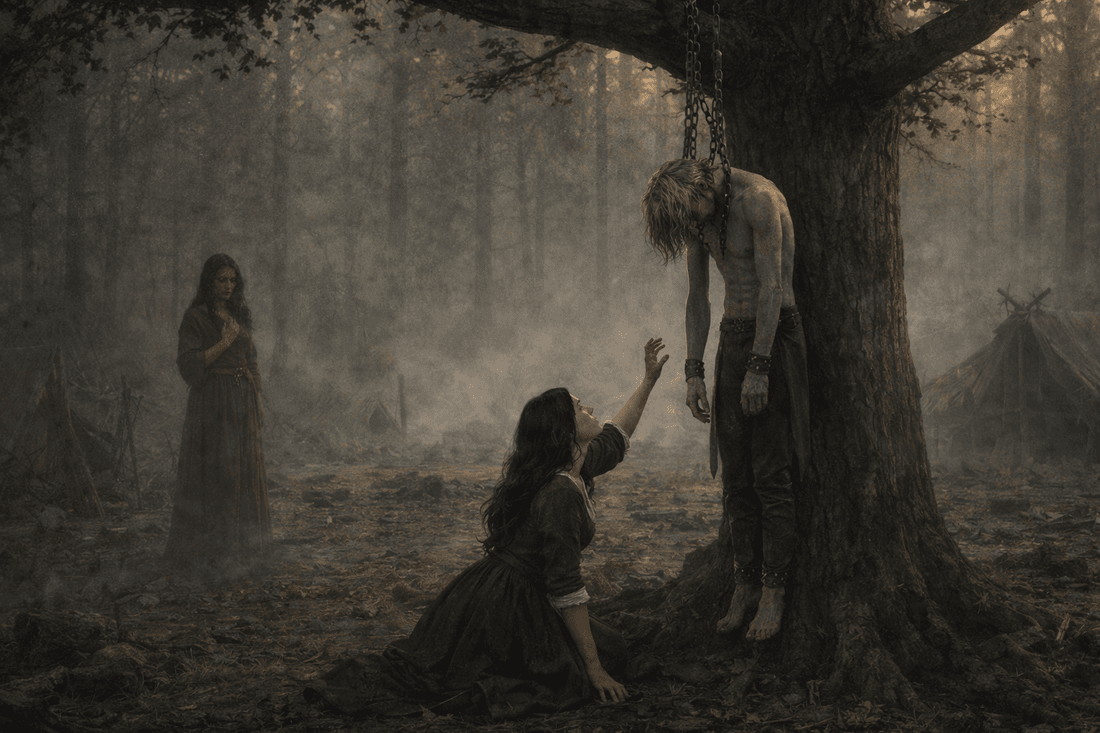
Caelith hung from its branches, iron chains cutting into pale flesh, his body limp and unmoving. His head had fallen forward, hair obscuring his face. There was no light left in him. No breath. No answering pull in her chest.
She staggered closer, her knees giving way as she collapsed beneath him.
“No,” she whispered. “No, no—please.”
The forest did not answer.
The woman behind her made a low, mournful sound, pressing a hand to her own heart before turning away, giving Mercy this grief alone.
Mercy reached for Caelith’s hand. It was cold.
The world tilted.
She bowed her head beneath him, her tears falling soundlessly into the blood-stained earth, something inside her breaking so completely she wondered how she still drew breath at all.
He had promised he would come.
He had promised he would not leave her.
Above her, the branches creaked softly in the wind, and Caelith’s body swayed once—slow, terrible, final.
And Mercy Hale understood, with a clarity that hollowed her to the bone, that the forest had taken him.
And that nothing—nothing—would ever be the same again.